

ASC 820 Level 1, Level 2 and Level 3 Inputs Explained
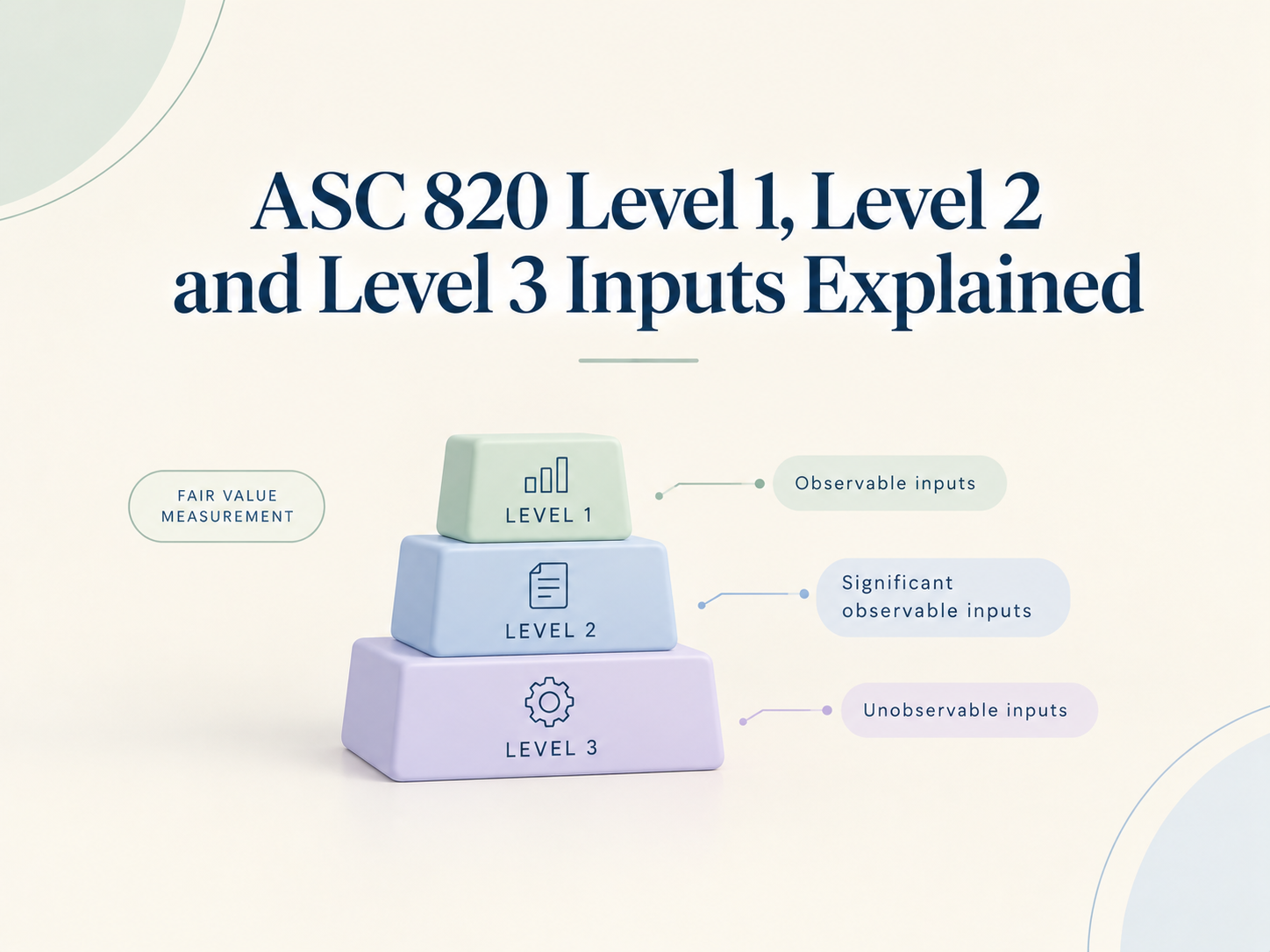
Understand ASC 820’s Level 1, Level 2, and Level 3 inputs, including how observable and unobservable inputs are used to measure fair value and assess valuation complexity and uncertainty.
When a company reports something at fair value, an obvious question follows: how much can you trust that number? ASC 820, the US GAAP fair value standard, answers with the fair value hierarchy. It sorts the inputs behind a valuation into three levels, from most observable to least.
Fair value is the price you would get to sell an asset, or pay to transfer a liability, in an orderly transaction between market participants on the measurement date. The hierarchy does not change that. It simply asks: what evidence did you use to get there? The more it comes from real markets, the higher up the hierarchy you sit.
Level 1: Quoted Prices
Level 1 uses quoted prices in active markets for identical assets or liabilities.
Think of a share of a listed company on a major stock exchange. You look up the price and that is the fair value. No adjustments, no judgment.
This is the most reliable level, and ASC 820 requires you to use the quoted price whenever one is available.
Level 2: Observable Inputs
Level 2 uses inputs you can see in the market, but which are not simple quoted prices for the identical item. These include:
- Prices of similar assets in active markets
- Prices of identical assets in markets that are not active
- Interest rates, yield curves and credit spreads
Think of a corporate bond that trades only occasionally, or an interest rate swap. There is no single quoted price, so you build the value from market data you can verify.
This level involves some judgment, but it is still anchored in observable evidence.
Level 3: Unobservable Inputs
Level 3 uses inputs that are not observable. They reflect your own assumptions about what market participants would use.
Think of a private company's shares, an earn-out in an acquisition, or customer relationships recognised in a purchase price allocation. There is no market price, so you rely on forecasts, growth rates, discount rates and marketability discounts.
This is the least observable level, because judgment drives the number. It also carries the heaviest disclosure.
Which Level Applies to the Whole Measurement?
A fair value often uses several inputs. The level of the overall measurement is set by the lowest-level input that is significant to the result. If a Level 2 valuation relies heavily on one unobservable assumption, the whole measurement is Level 3.
What Changes at Level 3?
Higher levels bring more disclosure. For Level 3, companies generally explain the valuation technique, the significant unobservable inputs and how the balance changed during the period. Requirements vary by entity type, so check the current standard for your situation.
Three Things People Often Get Wrong
A higher level is not always a better answer. The level describes how observable the inputs are, not whether the number is right. A well-supported Level 3 model can be more dependable than a stale price.
Adjustments can change the level. If you adjust a Level 2 price using significant unobservable data, the measurement moves to Level 3.
Levels can change over time. If a market becomes inactive, an asset can move from Level 1 to Level 2 or 3.
Use quoted prices when they exist. When they do not, use observable inputs. Rely on your own assumptions only as a last resort, and document them well. For Level 3 items, keep the supporting analysis ready, because auditors and investors will ask for it. If you report under Ind AS, the same three-level structure applies under Ind AS 113.