Loading…


Loading…
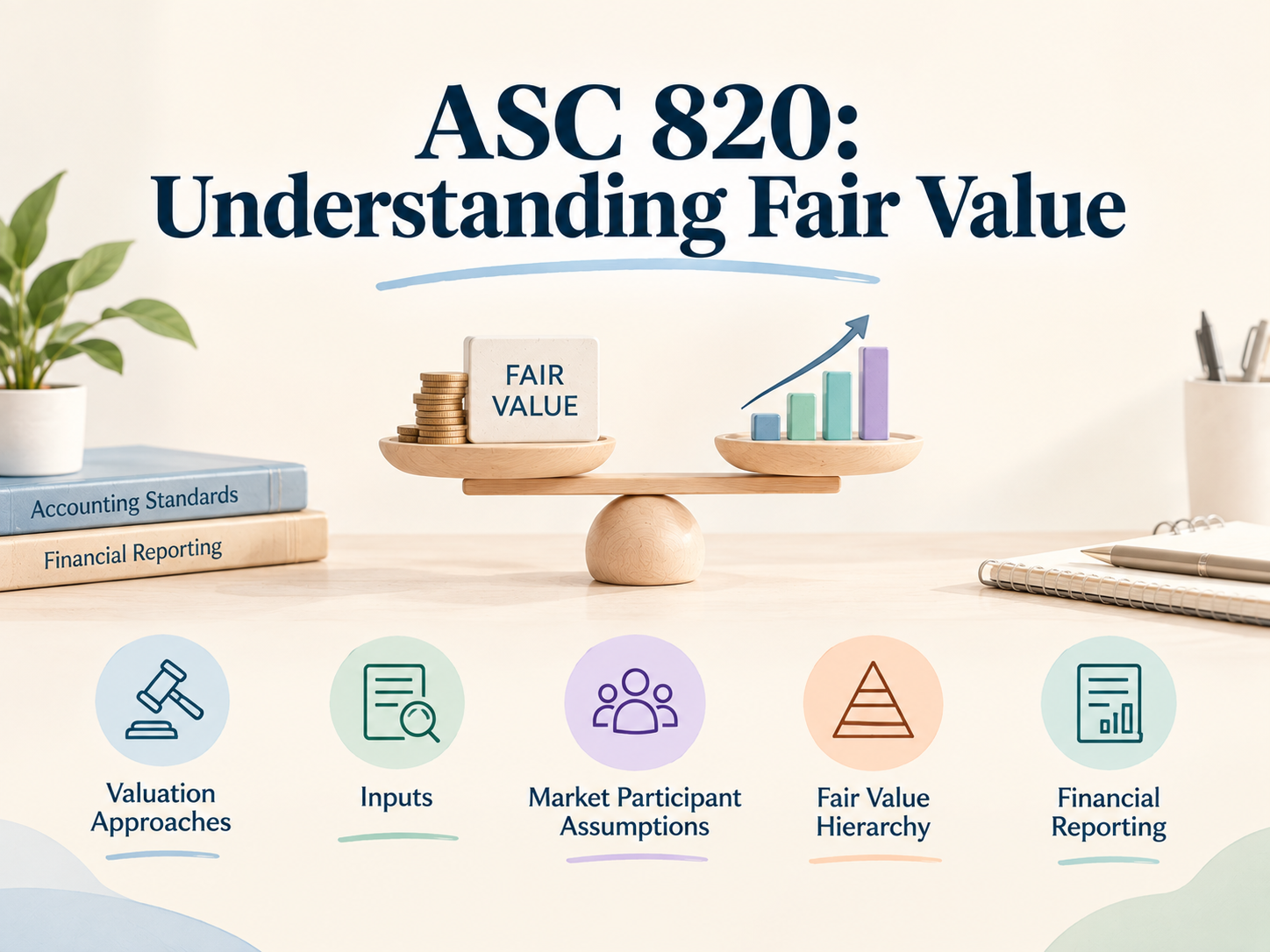
Understand ASC 820 and the principles behind fair value measurement, including valuation approaches, inputs, market participant assumptions, and the hierarchy used for financial reporting
ASC 820, issued by the Financial Accounting Standards Board (FASB), governs fair value measurement and disclosure under US GAAP. It applies across a wide range of financial reporting contexts from business combinations and impairment testing to financial instruments and investment property. This article outlines its core requirements and how they apply in practice.
ASC 820 defines fair value as the price that would be received to sell an asset, or paid to transfer a liability, in an orderly transaction between market participants at the measurement date.
This is a precise and deliberate definition. Fair value under ASC 820 is an exit price which is determined from the perspective of the market, not the reporting entity itself. It does not reflect management's internal opinion of value, the original acquisition cost, or benefits unique to the reporting company. It reflects what a hypothetical, rational market participant would pay.
The Market Participant Concept
A central principle of ASC 820 is that fair value must be assessed from the standpoint of a market participant,a hypothetical, independent, knowledgeable buyer or seller acting in their own economic interest, rather than the specific circumstances of the entity holding the asset.
This means entity-specific synergies are cost savings or advantages available only to the reporting company because of how its operations are structured and are generally excluded from the fair value measurement, unless a typical market participant would derive and price the same benefit. This requirement is what keeps fair value objective and comparable across different companies applying the standard.
The Fair Value Hierarchy
ASC 820 requires every fair value measurement to be classified within a three-level hierarchy, based on the observability of the inputs used to determine it:
Level 1 — Quoted prices in active markets. The most reliable category, applicable to assets such as listed equity securities, where a directly observable market price exists.
Level 2 — Observable inputs other than quoted prices. Used when no direct market price is available, but comparable market data exists — such as pricing for similar instruments or observable yield curves.
Level 3 — Unobservable inputs. Applied when no relevant market data exists, requiring internal assumptions and valuation models — for example, discounted cash flow analysis for an illiquid or privately held investment.
Level 3 measurements draw the greatest degree of regulatory and audit scrutiny, given the higher level of judgment required to support them.
Valuation Techniques Permitted Under ASC 820
ASC 820 recognizes three principal valuation approaches:
The appropriate technique depends on the nature of the asset or liability being measured and the availability of reliable, observable inputs. In many engagements, more than one approach is used and reconciled to arrive at a supportable conclusion.
ASC 820 imposes extensive disclosure obligations, particularly for Level 3 measurements. These typically include the valuation technique applied, the significant unobservable inputs used, and a quantitative sensitivity analysis showing how reported fair value would change under reasonably possible shifts in those inputs.
These disclosures exist to give investors, auditors, and other users of financial statements enough information to assess how reliable — and how sensitive — a reported fair value measurement actually is.
Why Does This Matters in Practice?
Fair value measurements under ASC 820 are rarely confined to a single footnote. They flow directly into reported goodwill, impairment charges, and the classification of financial instruments figures that materially affect profit, equity, and how a company's financial position is read by lenders, investors, and boards.
An unsupported or poorly documented Level 3 measurement is one of the most common issues identified in audit review, and it can resurface as a significant problem during a subsequent transaction, financing round, or regulatory inquiry.
Thus, ASC 820 establishes a rigorous, market-based framework for fair value measurement, built around objectivity, a defined hierarchy of inputs, and transparent disclosure of the judgment involved. A properly supported and well-documented ASC 820 valuation is essential not only for audit compliance, but for the overall credibility of the financial statements it underpins.