

How Cap Table Structure Affects 409A Valuation
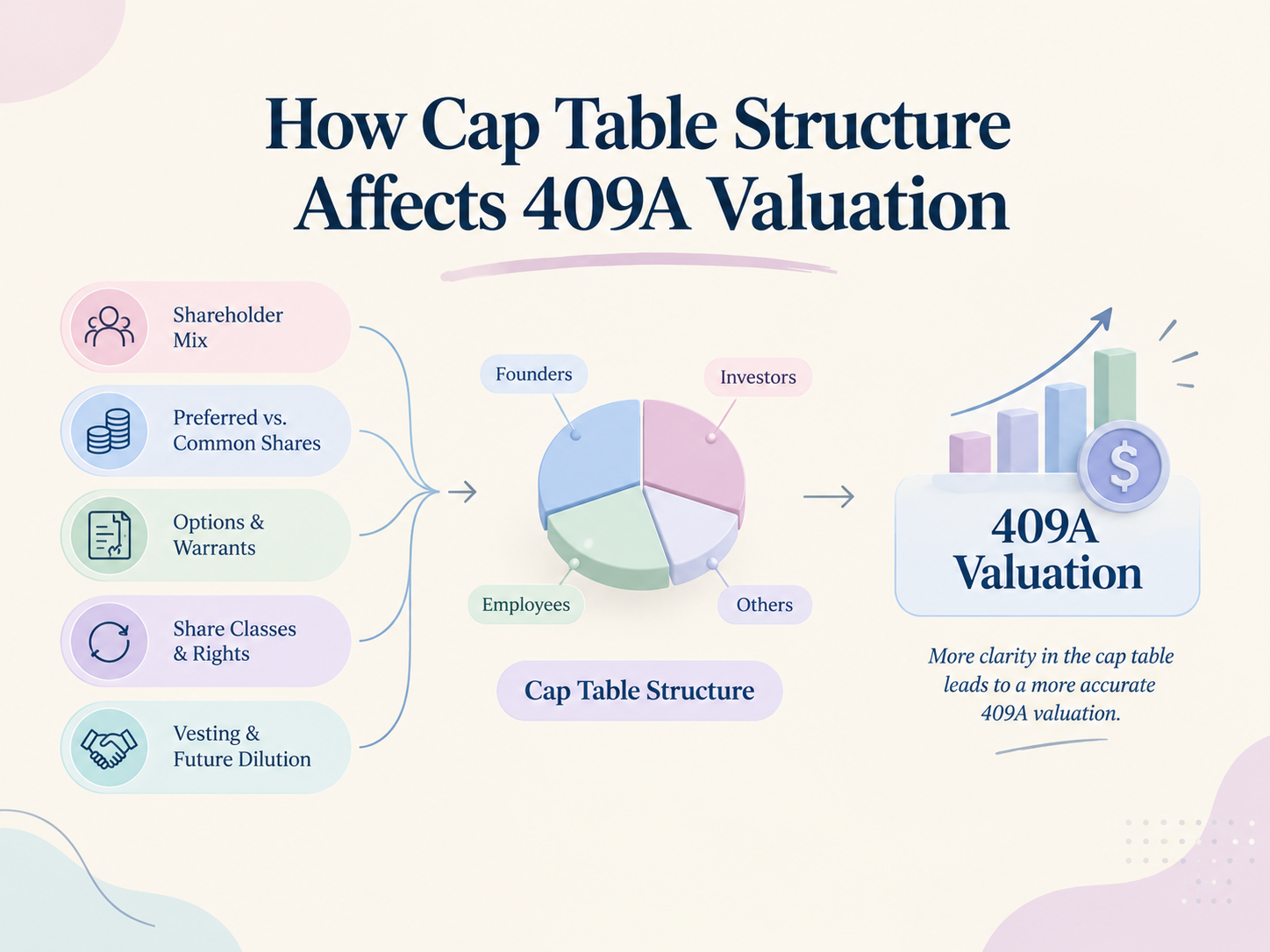
Understand how cap table structure influences 409A valuation, including preferred shares, options, convertible securities, ownership rights, and how these factors affect the value of common stock.
A Section 409A valuation ultimately comes down to one question: What is one share of the company’s common stock worth?
It may seem straightforward to divide the company’s equity value by the total number of shares, but that approach can be misleading. Two companies with the same equity value can have very different values for their common stock. The reason often lies in the cap table and, more specifically, the rights attached to each class of shares.
Why the Cap Table Matters
Employee stock options are generally granted over common stock, which typically sits at the bottom of the payout hierarchy. Preferred shareholders, on the other hand, usually have rights that allow them to receive proceeds before common shareholders. The greater the value claimed by those preferences, the less remains for common stock.
Consider a simplified example. Assume a company is sold for $30 million, and its investors hold senior preferred stock with a $20 million, 1x non-participating liquidation preference. The investors own 40% of the company on an as-converted basis.
If they converted to common stock, their 40% share would be worth $12 million. Instead, they would exercise their $20 million liquidation preference. That leaves $10 million for the common shareholders, who own the remaining 60%.
Without the preference, common shareholders would have received $18 million based on a simple 60/40 split. The company has the same $30 million sale value in both cases, but the amount reaching common shareholders changes significantly because of the capital structure.
Structural Features That Matter Most
Liquidation preference and multiples. A 1x liquidation preference generally allows an investor to recover its original investment before common shareholders receive proceeds. A 2x or 3x preference can claim substantially more of the proceeds before common receives anything.
Participation rights. Non-participating preferred stock generally requires the investor to choose between receiving its liquidation preference or converting to common stock. Participating preferred stock can receive the preference first and then participate in the remaining proceeds as well, subject to any applicable cap. This can significantly reduce the proceeds available to common shareholders.
Seniority. Different preferred rounds may have different levels of seniority. Later financing rounds may rank ahead of earlier rounds, while some structures give multiple rounds equal priority. These terms determine how proceeds are distributed, particularly when the exit value is limited.
Conversion and anti-dilution provisions. Conversion terms can affect how many common shares preferred investors receive when they convert. Anti-dilution provisions can also change the economics, particularly following a down round.
Cumulative dividends. If preferred shares carry cumulative dividends, the amount owed to preferred shareholders can increase over time. As a result, more of the company's value may be allocated to preferred stock before common shareholders receive proceeds.
Options, Warrants and Convertible Instruments
Outstanding options and warrants are also important because they represent potential claims on the company's equity. They generally only have value once the underlying share value exceeds the applicable exercise price, so they should not simply be treated as ordinary outstanding shares.
Convertible notes and SAFEs add another layer of complexity. They may not appear in the current priced share count, but they can convert into equity, often using a valuation cap or a discount. Ignoring these instruments can understate the potential dilution to common shareholders, while assuming they are fully converted too early can overstate it.
How Valuers Reflect the Capital Structure
When a company has multiple classes of equity with different rights, valuers need a method that reflects those differences rather than simply dividing the total equity value among all shares.
One commonly used approach is the Option Pricing Method (OPM). It treats the different equity classes somewhat like call options, with the applicable breakpoints determined by liquidation preferences, conversion rights and other terms.
When there has been a recent preferred stock financing, a backsolve method may also be used. This approach works backward from the price investors paid in the recent transaction to estimate the company's implied equity value and then allocates that value across the different classes of stock.
Whichever method is used, the underlying waterfall needs to reflect the actual terms of the company's financing arrangements. Working only from a summarized cap table can be risky. Important provisions may be contained in the company's charter, investor rights agreements or other financing documents and can materially affect the result.
A further consideration is the discount for lack of marketability (DLOM). Because privately held common stock cannot generally be sold as easily as publicly traded shares, a discount may be applied to reflect the lack of marketability. The appropriate discount can depend on factors such as the expected time to a liquidity event and the company's volatility.
Practical Considerations for Companies
Be careful when using the latest preferred share price. The price investors paid reflects preferred stock with specific rights and protections. It should not automatically be treated as the value of common stock. In many cases, common stock will be worth considerably less.
Keep the cap table up to date. Share counts, vesting schedules, options, warrants and convertible instruments all affect the valuation. Even small errors can flow directly into the final result.
Update the valuation after material events. A new financing, changes to preference terms, a significant acquisition or a major change in the company's financial performance can all affect the appropriate valuation. Keeping the valuation current is important when relying on an independent appraisal for Section 409A purposes.
Provide the underlying documents. A valuer should have access to relevant documents such as the certificate of incorporation, investor rights agreements, financing documents, notes and SAFEs not just a spreadsheet summarizing the cap table.
A Section 409A valuation is only as reliable as the capital structure information behind it. Liquidation preferences, participation rights, seniority, conversion provisions and convertible instruments can all affect how much of the company's value ultimately reaches common shareholders.
Getting those details right and making sure the valuation is updated when the company's capital structure or circumstances change. It is essential for arriving at a supportable common stock value and setting appropriate option exercise prices.