

How SAFEs Affect 409A Valuation
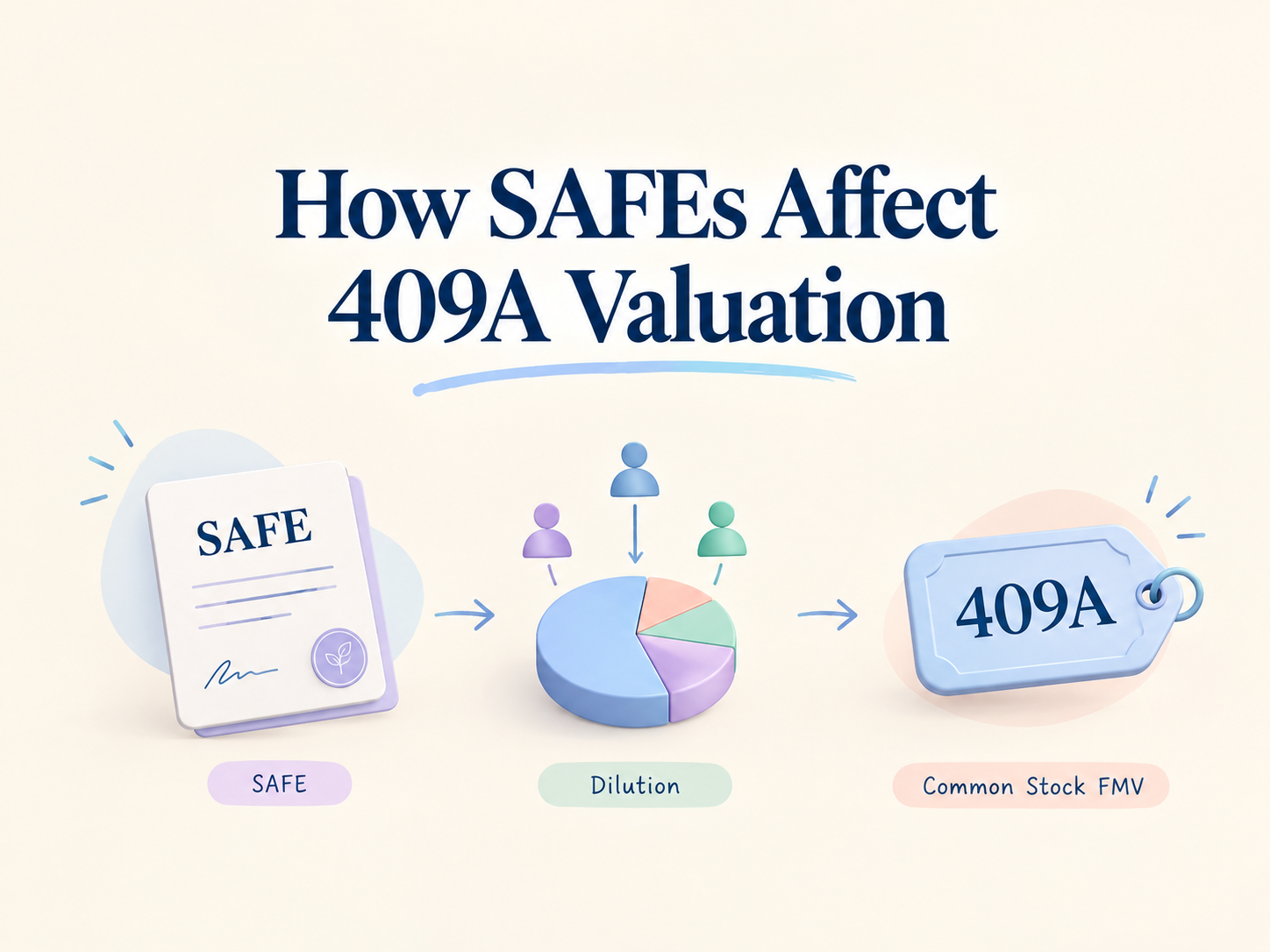
Understand how SAFEs can affect 409A valuation, including their impact on capitalization, future equity claims, valuation modeling, and the fair market value of a startup’s common stock.
A SAFE round does not establish a traditional share price, which can create a genuine challenge when preparing a 409A valuation. There is no priced equity round from which to derive a per-share value, yet the company has taken on a measurable future claim on its equity. Addressing this correctly requires understanding the nature and terms of a SAFE rather than treating it as either debt or conventional preferred equity. A SAFE is neither.
What Is a SAFEs?
A Simple Agreement for Future Equity (SAFE) gives an investor the right to receive equity upon a future triggering event, typically the next priced equity financing. Unlike a convertible note, a SAFE does not accrue interest and generally has no maturity date requiring repayment. This structure is one reason SAFEs are widely used for early-stage fundraising: they allow companies to raise capital without negotiating a full priced equity round.
However, the absence of a maturity date also means a SAFE can remain outstanding until a qualifying conversion event occurs. This creates an additional consideration when determining the value of the company's common stock for 409A purposes.
Why Do SAFEs Complicate the 409A Waterfall?
At the time a SAFE is issued, it is not part of the company's priced equity structure. However, it represents a contractual right to receive equity in the future and can therefore have a meaningful impact on the distribution of value among existing and future shareholders. Many SAFEs include a valuation cap, a discount to the next financing price, or both. These provisions determine the terms on which the SAFE will convert relative to the valuation established in the company's next priced financing.
As a result, a 409A valuation performed while SAFEs remain outstanding should generally reflect the economic terms of those instruments in the waterfall analysis. Simply ignoring outstanding SAFEs, or assuming they have already converted into common stock, may not accurately reflect the company's capitalization and the potential dilution to existing shareholders.
For example, a SAFE with a valuation cap significantly below the company's current implied value may result in substantial dilution upon conversion. That potential dilution can affect the value attributable to existing common shareholders and therefore needs to be considered when determining the fair market value of common stock.
Pre-Money and Post-Money SAFEs Can Produce Different Results
The distinction between pre-money and post-money SAFEs is particularly important when multiple SAFEs are outstanding.
A post-money SAFE generally establishes the investor's ownership percentage based on the company's capitalization immediately following the conversion of that SAFE. When several post-money SAFEs are issued to different investors, their individual ownership calculations can compound, potentially resulting in greater aggregate dilution than founders initially anticipate.
Pre-money SAFEs operate differently because their conversion economics are based on the company's value before the SAFE financing is taken into account.
For a 409A valuation, the specific structure and terms of each outstanding SAFE therefore matter. The valuation should reflect the actual contractual terms and the interaction among multiple outstanding instruments rather than relying on a generic dilution assumption.
Does a SAFE Financing Trigger a New 409A Valuation?
A SAFE financing does not establish a per-share price in the same way as a traditional priced equity financing. As a result, it does not automatically function as the type of transaction that would typically reset a 409A valuation based on a new preferred stock price.
However, that does not mean a SAFE financing should automatically be disregarded when considering whether an existing 409A remains appropriate.
A significant SAFE financing can represent a material change in the company's circumstances. The company has received new capital, its capitalization has changed, and the financing may provide information about the company's current market position and expected trajectory.
The appropriate approach is therefore to assess whether the SAFE financing represents a material event that could affect the company's fair market value, rather than assuming that the existing 409A remains appropriate simply because the financing did not establish a priced share value.
Practical Considerations for a 409A Valuation
When a company has outstanding SAFEs, several considerations are particularly important:
Model each outstanding SAFE separately. The valuation should account for the specific valuation cap, discount, and pre-money or post-money structure applicable to each instrument.
Analyze the combined effect of multiple SAFEs. Several outstanding post-money SAFEs can create significant aggregate dilution, and evaluating each instrument independently may not capture the full effect on existing shareholders.
Evaluate whether a significant SAFE financing represents a material event. Although a SAFE does not establish a traditional share price, a substantial financing may still warrant a reassessment of the company's existing 409A valuation.
SAFEs occupy a distinct position in the capitalization structure. They are not traditional debt and are not priced equity, but they represent contractual rights to future equity that can materially affect the allocation of value among shareholders. For 409A purposes, outstanding SAFEs should therefore be explicitly considered in the capitalization and waterfall analysis. Properly modeling their terms and potential dilution helps ensure that the value attributed to common stock reflects the company's actual capitalization and provides a more supportable basis for determining the 409A fair market value and related option strike price.