
How Treasury Rates Affect Cost of Equity in Business Valuation
Understand how Treasury rates influence the cost of equity in business valuation, including their impact on the risk-free rate, discount rates, required returns, and ultimately the value of a business.
Every cost of equity calculation built on CAPM starts with the same first input: a risk-free rate, almost always drawn from US Treasury yields. This single number anchors an entire discount rate calculation, and by extension, an entire valuation, yet the choice of which Treasury yield to use, and how to use it, involves considerably more judgment than practitioners often acknowledge.
Why Treasury Yields Anchor the Risk-Free Rate
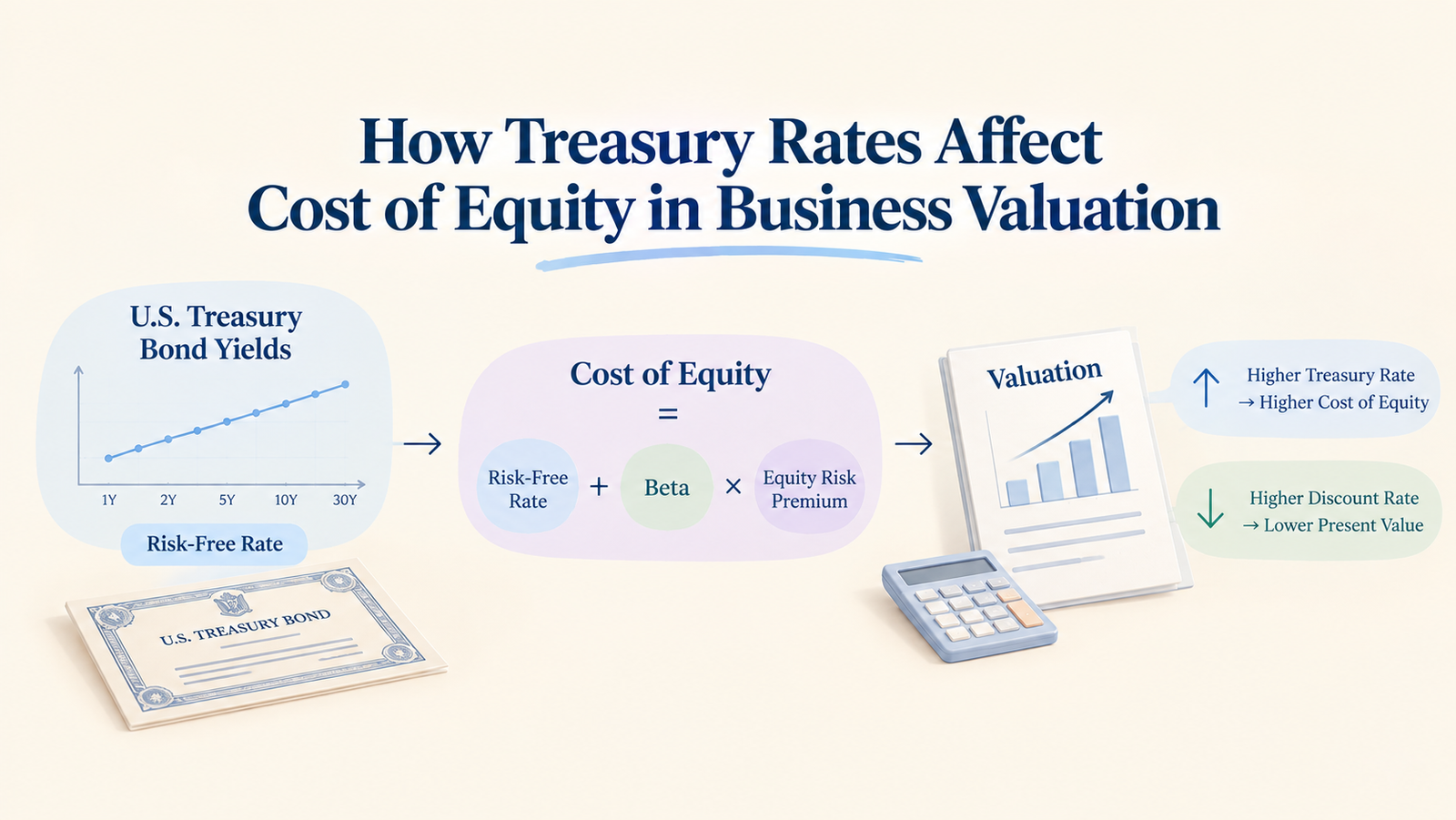
The risk-free rate is meant to represent the return available with essentially no default risk over the relevant investment horizon. US Treasury securities, backed by the full faith and credit of the federal government, are the standard proxy, since no other widely available instrument offers comparably low credit risk across a range of maturities.
The choice of maturity matters more than it might seem. A value that includes cash flows that go out in the time should usually use a Treasury rate that is for a longer time. Often the 10-year one or the 20-year one. To match the time period that is actually being looked at instead of a short-term Treasury bill rate that shows what is happening with money policy right now more, than what is expected to happen in the long run.
The Direct Mechanical Effect
Under CAPM, cost of equity equals the risk-free rate, plus beta multiplied by the equity risk premium. When Treasury yields rise, cost of equity rises by that same amount, holding beta and the equity risk premium constant . A mechanical, near-automatic transmission from bond markets directly into equity valuation.
This effect compounds through WACC and into the discount rate applied to every year of projected cash flow, and disproportionately into terminal value, which is typically the largest single component of a DCF valuation and is calculated by dividing by the gap between the discount rate and the long-term growth rate. A rise in Treasury yields that pushes the discount rate up by even half a percentage point can move terminal value, and the resulting valuation, considerably more than that same shift moves near-term cash flow present values.
Why the Relationship Isn't Always This Clean
The equity risk premium itself doesn't stay fixed as Treasury yields move, which complicates a purely mechanical read of this relationship. Historically when Treasury yields go up quickly the equity risk premium tends to get smaller. Investors look at how attractive different assets are compared to each other. This means that the cost of equity doesn’t always rise in step, with the risk- rate. The CAPM formula if used without thinking assumes the risk premium stays the same.. In reality it doesn’t always work that way.
This is exactly why valuation practitioners debate whether to use the current spot Treasury yield at the valuation date, or a longer-term normalized rate that smooths out short-term volatility in Treasury markets. Using a spot rate that was taken during a period, such, as a sharp and possibly temporary yield spike can lead to a discount rate that overstates a company’s true long‑term cost of capital. On the hand using a normalized rate might understate the current market conditions if rates have truly moved to a new more lasting level.
Practical Implications for a Valuation Prepared Today
Match the Treasury maturity to the valuation's actual duration, rather than defaulting to whichever yield happens to be most commonly cited, since a mismatch introduces an error that compounds across the entire discounting period.
Document whether a spot or normalized rate was used, and why. A valuation prepared during a period of unusual Treasury market volatility should explain this choice explicitly, since it's exactly the kind of assumption an auditor or opposing expert is likely to challenge directly.
Revisit the equity risk premium assumption alongside the risk-free rate, rather than holding it fixed by default, given the documented tendency for the two to interact rather than move entirely independently of each other.
Recognize those with leveraged capital structures face a compounding effect, since rising Treasury yields tend to coincide with rising borrowing costs as well, affecting both the equity and debt components of WACC simultaneously
Treasury yields don't just influence bond markets — they flow directly into cost of equity, and from there into every discounted cash flow valuation built on CAPM. Given how sensitive terminal value is to small shifts in the discount rate, the specific Treasury maturity chosen, and the reasoning behind using a spot versus normalized rate, deserve the same explicit documentation and scrutiny as any other consequential valuation assumption.