
US Tax Reform: Impact on Private Company Valuations
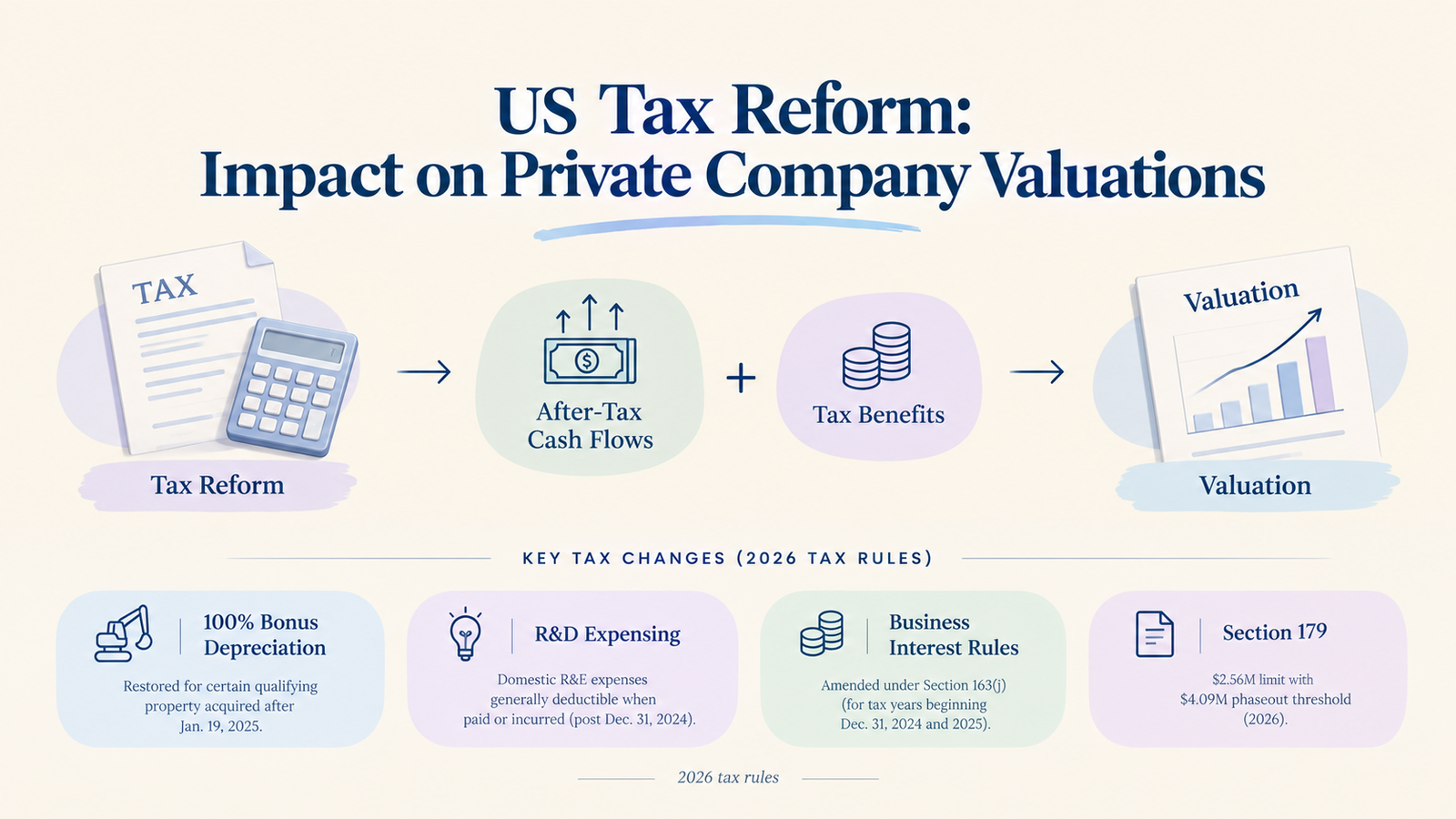
Explore how U.S. tax reform can affect private company valuations, including changes in cash flows, tax rates, capital investment, risk, and the assumptions used in business valuation models.
On July 4, 2025, the One Big Beautiful Bill Act became law, bringing some of the biggest business tax changes in years. Unlike a typical tax update that mostly affects your year-end tax bill, several of these changes actually flow straight into the cash flow numbers and assumptions used to value a private company. If you're valuing a business today, these changes matter just as much as the operating projections themselves.
Full, Immediate Depreciation Changes the Cash Flow Story
The new law permanently brought back 100% bonus depreciation for qualifying property bought after January 19, 2025. Reversing a phase-down that had already dropped the rate to 40% and was set to fall even further. In plain terms: for a business that invests in new equipment or property, the tax benefit now shows up immediately instead of being spread out over several years.
For a DCF valuation, this means near-term cash flow looks meaningfully better than it would have under the old phase-down schedule, since the tax savings arrive right away instead of trickling in. If a valuation model is still using the older depreciation assumptions, it's understating near-term cash flow for any business making real capital investments. And because this change is permanent rather than temporary, it also removes a layer of "will this get extended?" uncertainty that used to sit inside longer-term projections.
Immediate R&D Write-Offs Are a Big Deal for Tech and Innovation-Heavy Businesses
Companies can now deduct domestic research and development costs right away, instead of being forced to spread them out over five years. There's even retroactive relief letting companies catch up on unamortized R&D costs from 2022 through 2024. One catch worth knowing: R&D done overseas still has to be spread out over 15 years, which creates a real incentive to keep research work domestic.
For any tech, biotech, or R&D-heavy private company, this genuinely improves near-term after-tax cash flow compared to older projections. Anyone valuing this kind of business needs to actually rebuild the tax treatment of R&D spending, not just carry forward assumptions from an older model.
Changes to Qualified Small Business Stock (QSBS) Affect How Founders Think About Exits
For qualifying small business stock issued after July 4, 2025, the tax break for selling it got more generous and more flexible. Instead of an all-or-nothing five-year holding requirement, there's now a sliding scale: 50% of your gain is tax-free after three years, 75% after four years, and the full 100% after five years. The cap on how much gain you can exclude also went up, from $10 million to $15 million per person, and the size limit for qualifying companies increased too.
This doesn't change what a company is actually worth but it changes how much money founders and early investors actually keep after selling, and that can shift the whole conversation around exit timing. A founder deciding between selling now or waiting it out now has a much more nuanced decision to make than the old "wait five years or get nothing" rule created.
Not Every State Is Playing Along
Here's a wrinkle worth knowing: several states haven't adopted these federal changes. Some still require R&D costs to be spread out, and some haven't adopted the new depreciation or QSBS rules at the state level either. That means a company's actual tax bill can look quite different depending on federal versus state rules therefore anyone doing a valuation needs to track both separately, rather than assuming they match.
What This Means If You're Valuing a Business Right Now
Don't just reuse an old blended tax rate. Actually rebuild the tax assumptions with these specific changes in mind, especially for a business that invests heavily in equipment or R&D.
Track state and federal rules separately, since they're increasingly out of sync with each other.
If QSBS applies, rethink the exit timing math. The new sliding scale changes how a founder should think about holding period in a way the old rules never did.
A tax change this big doesn't just affect a company's tax bill for the year — it flows straight into projected cash flow, tax rates, and what founders actually walk away with at exit, all of which feed directly into how a private company gets valued. A valuation still built on the old tax rules is working off outdated assumptions, no matter how solid the rest of its projections look.