

Waterfall Analysis: Valuing Complex Capital Structures
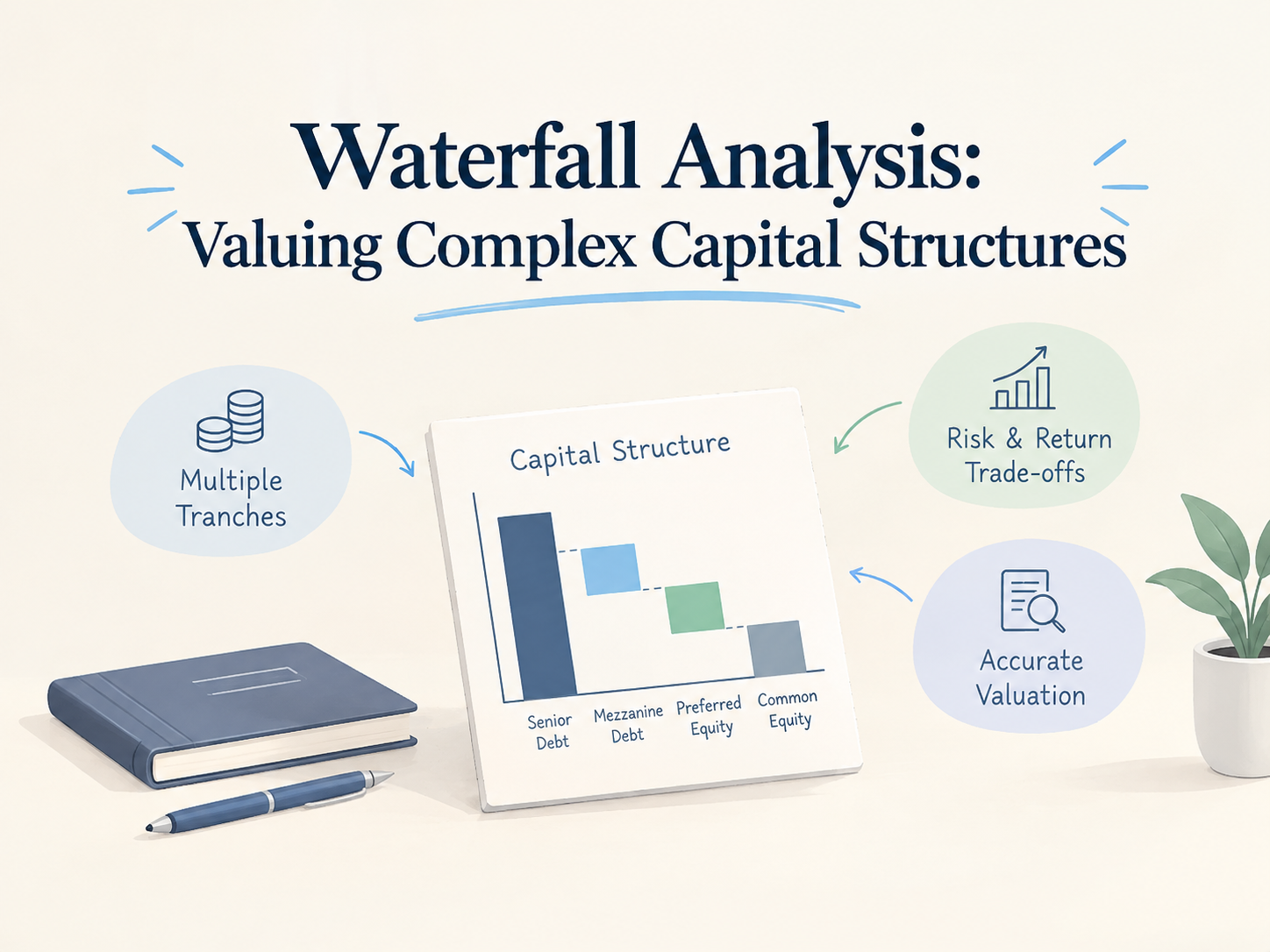
Learn how waterfall analysis helps value complex capital structures by allocating equity value across different share classes, liquidation preferences, conversion rights, and other ownership terms.
When a company leaves the market. By being sold going public or being closed down. The money made isn't just split up based on how much each person owns. They flow through a specific, contractually defined sequence, with certain share classes paid before others, and some entitled to more than a pro-rata share even after everyone else is paid. Waterfall analysis models exactly how that sequence plays out at a given exit value, and it sits underneath nearly every serious valuation involving a multi-round cap table.
Why This Isn't Optional for a Multi-Round Company
A company with several priced rounds typically has multiple layers of preference stock, each with its own liquidation preference and often its own seniority. Modeling total value and dividing it evenly across all shares, ignoring this structure, produces a number with no real relationship to what any specific shareholder common or preferred would actually receive.
This is precisely the calculation underlying the breakpoints in an OPM allocation, the scenario payoffs in a PWERM analysis, and any Backsolve exercise reconciling a known price to implied total equity value. Waterfall analysis isn't a standalone technique, it's the mechanical engine every one of these other methods runs on.
The Building Blocks of a Waterfall
Liquidation preference. Each preferred round typically carries a defined multiple of its investment. Commonly 1x, though higher multiples appear in some structures. And is paid to the preferred round before anything flows to the junior classes.
Seniority structure. Preference stacks can be senior/subordinate, where later rounds get paid ahead of earlier ones, or pari passu, where multiple rounds share pro-rata within the same tier. This one structural choice can dramatically change how a modest exit value distributes.
Participation rights. Non-participating preferred shareholders choose between their liquidation preference or converting to common whichever pays more. Participating preferred takes its preference and then also shares in remaining proceeds alongside common, unless a cap limits that upside.
Conversion decision points. At certain exit values, it becomes better for a preferred class to convert to common than take its stated preference. These thresholds are exactly the breakpoints an OPM allocation needs to identify precisely.
Where Waterfall Models Commonly Go Wrong
Treating all preferred shares as economically identical. A cap table that includes five funding rounds never has five same sets of terms. If you assume they are the same instead of creating a model, for each rounds real preferences, priority and involvement terms it leads to a very incorrect result.
Missing the conversion decision entirely. A static model assuming every preferred class always takes its preference, or always converts, rather than testing which is actually optimal at each exit value, misses the core logic that makes a waterfall a waterfall.
Ignoring cumulative dividends. Where preferred stock carries cumulative dividend rights, the amount owed before common gets paid grows over time, and stale accrual figures understate what that class is actually entitled to.
Never updating the model. A cap table changes, with every funding round every option grant and every amendment. Relying on year’s cap table to predict this year’s ownership distribution won’t give you an accurate picture. The numbers shift constantly. The old data doesn’t reflect the current reality.
Why This Matters Beyond a Single Exit Scenario
Waterfall analysis isn't only relevant when an actual exit is imminent. It's the foundation for common stock valuation used in ESOP strike pricing, for the OPM allocation used in Rule 57 and Ind AS 102 fair value work, and for understanding what a specific investor or founder actually stands to receive across a realistic range of future outcomes and not just the single exit value everyone happens to be discussing at the moment.
A waterfall model is only as reliable as how faithfully it reflects the actual terms in the shareholders' agreement . Every preference amount, every seniority relationship, every participation cap, and every conversion decision genuinely modeled rather than assumed away for simplicity. Getting this structure right is what separates a valuation that holds up under real scrutiny from one that quietly misallocates value the moment someone actually reads the cap table's fine print.