
How Free Cash Flow Conversion Affects Company Value
Understand how free cash flow conversion affects company value, including its impact on cash generation, financial quality, valuation multiples, investor confidence, and long-term business performance.
Profit is an accounting measure. Free cash flow is the cash a business actually has available after funding its operations and necessary investments. The gap between the two can tell you a lot about the quality of a company's earnings—and ultimately, its valuation.
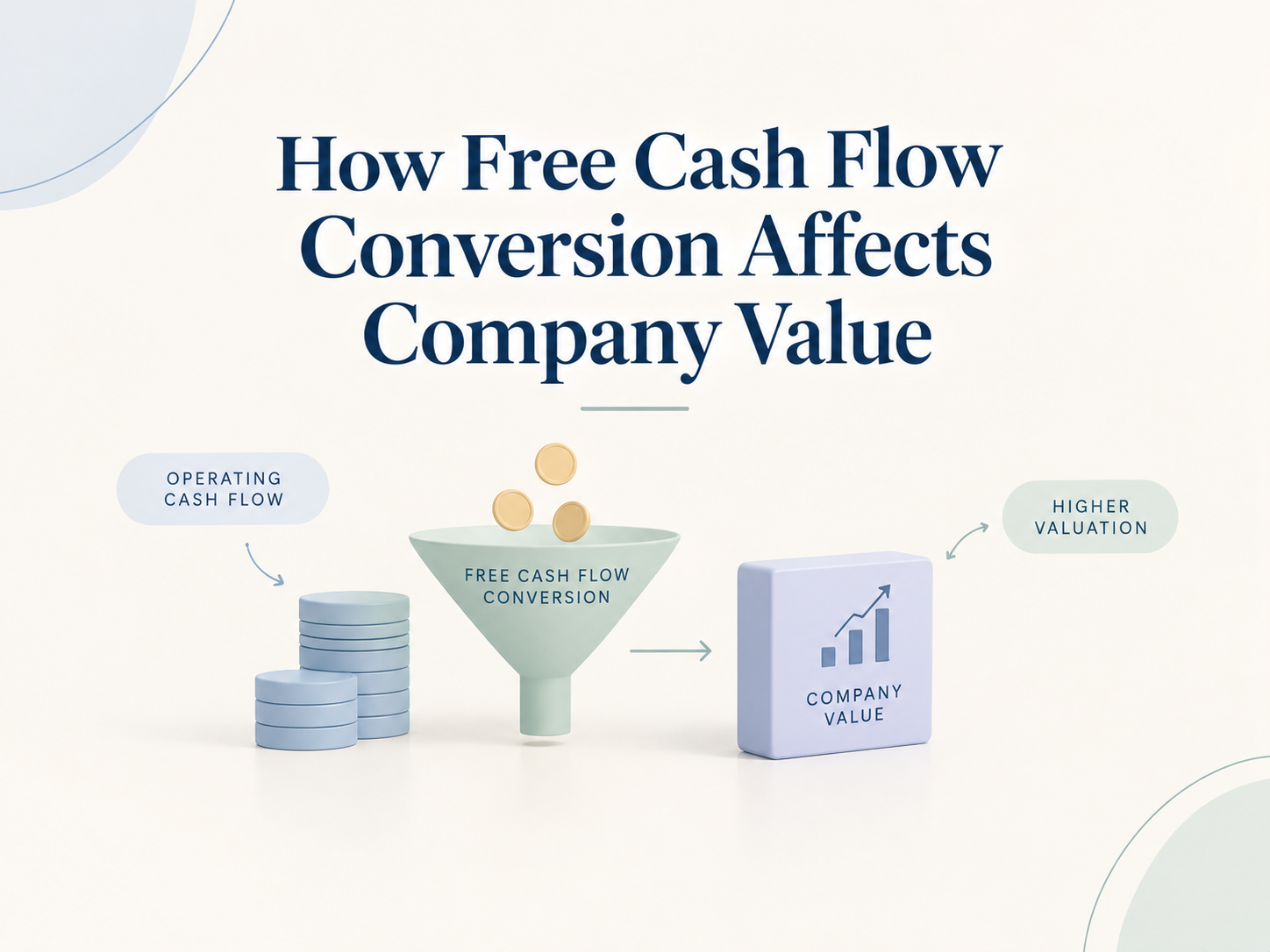
This is where free cash flow conversion becomes important. It measures how effectively a company turns reported earnings into actual cash and can help explain why two businesses with similar profits or EBITDA can have very different valuations.
What Is Free Cash Flow Conversion?
Free cash flow (FCF) conversion measures the proportion of earnings that ultimately becomes free cash flow.
A commonly used formula is:
FCF Conversion = Free Cash Flow ÷ EBITDA
It can also be calculated using net income, depending on the purpose of the analysis.
Free cash flow is generally calculated as:
Free Cash Flow = Operating Cash Flow − Capital Expenditure
For example, suppose a company generates ₹100 crore of EBITDA and produces ₹70 crore of free cash flow. Its FCF conversion is 70%.
If a competing company also generates ₹100 crore of EBITDA but produces only ₹30 crore of free cash flow, its conversion is just 30%.
Both companies may look similar based on EBITDA, but the amount of cash actually being generated is very different.
Why Does Free Cash Flow Conversion Matter for Valuation?
A company's intrinsic value is ultimately based on the future cash flows it can generate, not simply its accounting profit.This is particularly important in a discounted cash flow (DCF) valuation, where projected free cash flows are discounted back to their present value.
Two businesses with identical EBITDA can therefore have very different valuations if one consistently converts more of its earnings into cash.Higher conversion can also indicate that earnings are more readily available for reinvestment, debt repayment, acquisitions, or distributions to shareholders.
What Drives Free Cash Flow Conversion?
Several factors can cause a company's cash flow conversion to be high or low.
1. Capital Expenditure
Businesses that require regular investment in machinery, equipment, technology, or infrastructure generally convert less of their earnings into free cash flow.An asset-light software or professional services business may require relatively little capital expenditure, allowing a larger portion of EBITDA to become free cash flow.
A manufacturing or infrastructure company may need significant ongoing investment simply to maintain its existing operations.
2. Working Capital
Working capital can have a major impact on cash conversion. When receivables or inventory increase, cash can become tied up in the business even though revenue and profit have already been recognised.
For example, a company may report strong revenue growth but see little corresponding increase in cash because customers are taking longer to pay. This is why valuers should examine receivable days, inventory levels, payable days, and overall working capital requirements rather than looking at EBITDA alone.
3. Taxes and Other Cash Costs
Cash taxes, restructuring payments, interest costs, and other cash expenses can also affect the amount of cash ultimately available to the business. Two companies with similar EBITDA can therefore produce very different free cash flows because their underlying cash requirements are different.
How Does FCF Conversion Affect Valuation Multiples?
Free cash flow conversion can influence valuation through both the cash flow forecast and the valuation multiple. Investors are generally willing to pay more for a business that consistently converts a high proportion of its earnings into cash. Each rupee of EBITDA is more valuable when a larger portion of it becomes usable cash.
A company reporting strong EBITDA but consistently weak cash conversion may therefore trade at a lower EV/EBITDA multiple than its earnings alone would suggest. Consistency matters as well.
A company that converts 65% of EBITDA into free cash flow year after year may be viewed more favourably than one that fluctuates between 90% and 20%. Predictable cash flows are easier to forecast and generally carry less valuation risk.
Warning Signs During Valuation
A low or declining conversion rate does not automatically mean something is wrong, but it deserves investigation.
Some common warning signs include:
- Profit or EBITDA growing faster than operating cash flow, potentially indicating rising receivables or aggressive revenue recognition.
- Capital expenditure consistently exceeding depreciation, which may indicate that reported earnings are not fully reflecting the investment required to maintain the business.
- Strong conversion caused by a one-time working capital release, which may not be sustainable.
- Capitalised costs, where expenses are recorded as assets rather than immediately recognised in the P&L, potentially boosting reported EBITDA while cash still leaves the business.
A single year's conversion rate can be misleading. Looking at several years and understanding what caused the changes generally provides a much better picture.
Growth Capex vs. Maintenance Capex
One important consideration is the difference between growth capital expenditure and maintenance capital expenditure. A growing company may have temporarily weak free cash flow because it is investing heavily in expansion. That does not necessarily indicate poor economics if those investments generate attractive returns in the future.
The opposite can also happen. A company may show strong cash conversion because it is under-investing in its existing assets. That can make current free cash flow look better than the sustainable long-term figure. For this reason, valuers need to understand why the company is spending money, not just how much it is spending.
How Should Valuers Use FCF Conversion?
In a DCF valuation, free cash flow conversion should be considered when forecasting capital expenditure and working capital rather than simply applying a fixed percentage to EBITDA. In a market multiples valuation, conversion can help explain why a company deserves a premium or discount to comparable businesses.
For acquisitions, it can also help determine how much debt a business can realistically support. Lenders and financial sponsors ultimately care about the cash available for debt servicing, not just headline EBITDA.
Free cash flow conversion connects reported earnings with the cash that ultimately drives business value. High and stable conversion generally supports stronger valuations because it produces more cash for shareholders, debt repayment, reinvestment, and future growth.
Low or inconsistent conversion does not automatically make a business less attractive, but it raises important questions about capital expenditure, working capital, taxes, and the sustainability of reported earnings. For a meaningful business valuation, EBITDA is only part of the story. Understanding how much of that EBITDA actually turns into free cash flow and why provides a much clearer picture of the company's underlying value.