
How to Value a Company With Negative EBITDA
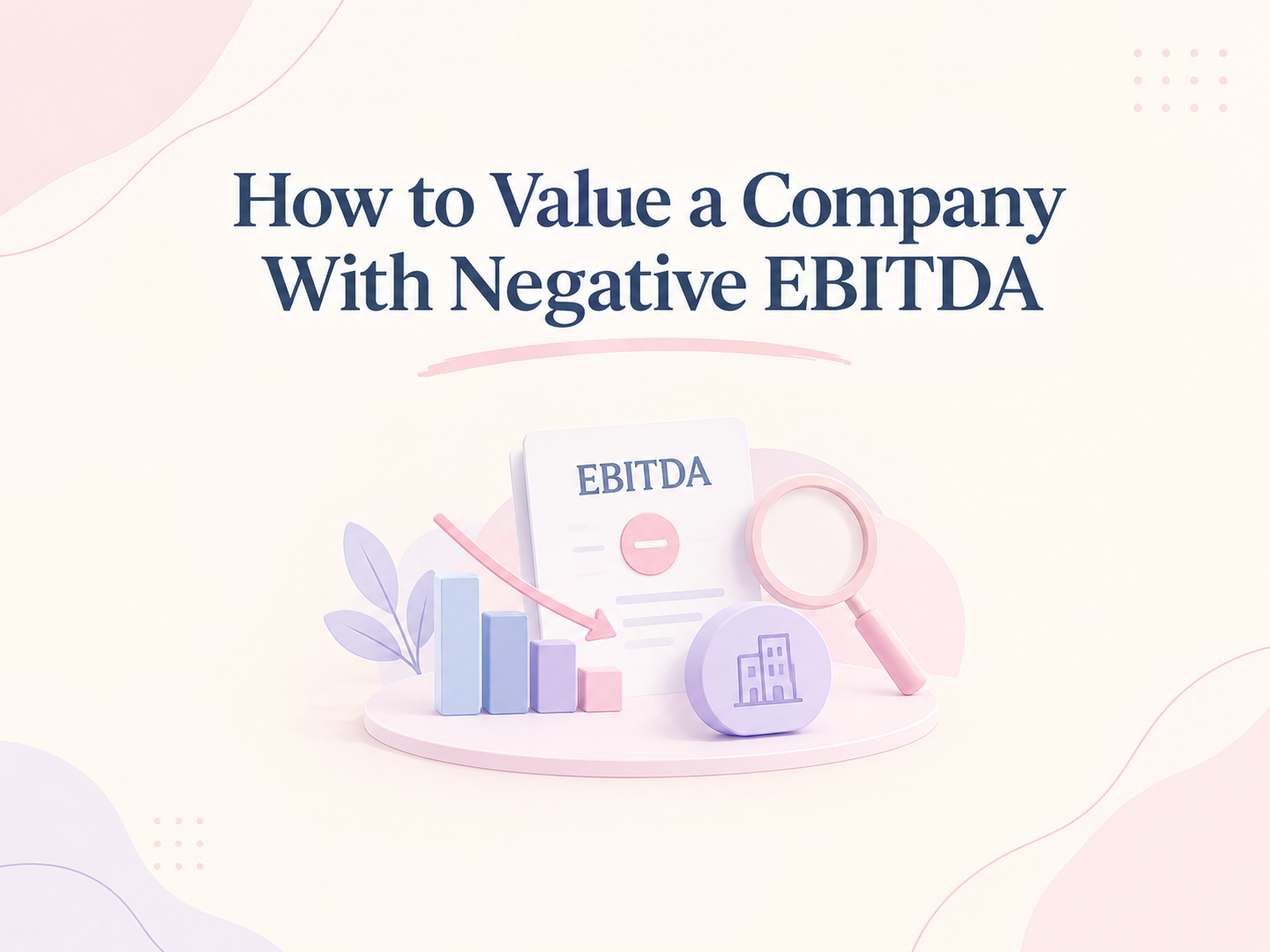
Explore how to value a company with negative EBITDA using alternative approaches, including revenue multiples, DCF, comparable transactions, and asset-based methods when traditional EBITDA multiples are not meaningful.
Negative EBITDA does not mean a company has no value. It simply means that one of the most commonly used valuation shortcuts is no longer useful. The challenge is knowing which methods make more sense instead.
Why the Usual Formula Stops Working
The EV/EBITDA approach is straightforward. You take EBITDA and apply an appropriate industry multiple. But when EBITDA is negative, the calculation no longer gives you a meaningful result.
A negative EBITDA multiplied by a positive multiple produces a negative enterprise value, which clearly does not reflect the value of a company that has customers, assets, intellectual property, or future growth potential.
This situation is common in:
• Early stage startups that are still building scale
• High growth companies that are investing heavily ahead of revenue
• Turnaround businesses that are working their way back to profitability
In these situations, the answer is not to force an EBITDA multiple into the analysis.
Other valuation approaches need to be considered.
1. Revenue Multiples
When EBITDA is negative, revenue is often the most practical starting point because it is usually positive.The EV/Revenue multiple is therefore commonly used for companies that are not yet profitable. The limitation is that revenue does not tell you much about profitability or operating efficiency. Two companies can generate the same revenue while having very different cost structures and long term prospects.
The revenue multiple should therefore be considered alongside factors such as:
• Revenue growth
• Gross margin
• Operating margins
• Progress toward breakeven
2. Gross Profit Can Provide More Context
For some businesses, gross profit can provide a better basis for comparison than revenue.Gross profit takes the cost of goods or services into account and can give a clearer picture of the economics of the underlying business before expenses such as sales, marketing, and R&D. This can be particularly useful when comparing companies with different business models or significantly different cost structures.
3. DCF Still Works, But the Forecast Matters More
A discounted cash flow model can still be used when EBITDA is negative. The challenge is that the valuation depends much more heavily on what happens in the years ahead. The model needs to establish a reasonable path from current losses to sustainable profitability. That means considering:
• When the company is expected to reach breakeven
• What operating margins could look like once it reaches scale
• How much additional capital the business may need before becoming self sustaining.
Because these assumptions can have a significant impact on value, it is usually helpful to consider multiple scenarios rather than relying on a single forecast.
4. Precedent Transactions
Another approach is to look at what comparable companies have actually sold for.
Precedent transactions can provide useful market evidence, particularly when there are recent deals involving businesses with similar growth rates, business models, and market positions.
The challenge is finding transactions that are genuinely comparable. Private transactions may also have limited publicly available information, especially in newer or rapidly changing industries.
5. The Venture Capital Method
The Venture Capital Method can be particularly relevant for early stage companies.
Instead of focusing heavily on the company's current financial performance, the analysis starts with an estimated future exit value, such as a potential acquisition or IPO. That future value is then discounted back to the present using a required return that reflects the risks associated with an early stage investment.
The approach is essentially focused on the company's potential future value and the uncertainty involved in getting there.
6. Financial Metrics Are Only Part of the Picture
For a company that is still generating losses, financial statements do not always tell the whole story.
Other factors can also be important, including:
• Customer growth and retention
• Total addressable market
• Competitive position
• Strength and experience of the management team
• Progress toward profitability
• Ability to raise additional capital
A company can be losing money today and still have significant value if there is credible evidence that it can build a scalable and profitable business over time.
7. Cash Burn and Runway Matter
Two companies can have similar valuations but very different levels of financial risk.One may have only a few months of cash remaining, while another may have enough cash to fund operations for several years.
That difference matters when assessing the company's risk and the assumptions used in the valuation. Cash burn and runway should therefore be part of the broader valuation analysis rather than treated as an afterthought.
Bringing the Methods Together
There is rarely one valuation method that tells the entire story when EBITDA is negative.
A more practical approach is to use several methods together.
Revenue or gross profit multiples can provide an initial market based range.
DCF analysis can test that range against the company's expected growth, profitability, and cash requirements.
Precedent transactions can provide another market reference point.
Business fundamentals and cash runway can help explain why the company may fall toward one part of the valuation range rather than another.
The goal is not to make every method produce the same number. The goal is to understand why the methods differ and whether the overall valuation makes sense.
Negative EBITDA does not make a company impossible to value. It simply means EBITDA is not currently a useful metric for applying a traditional earnings multiple.
For companies that are still growing, investing heavily, or working toward profitability, valuation often requires a combination of revenue or gross profit multiples, DCF analysis, precedent transactions, and a closer look at the company's underlying business fundamentals.
The key is to choose methods that reflect where the company is today while also accounting for where the business is realistically expected to go.