
Is Valuation Based on Revenue or Profit?
Understand whether business valuation is driven by revenue or profit, and how factors such as growth, margins, cash flow, industry, and risk determine which metric matters most.
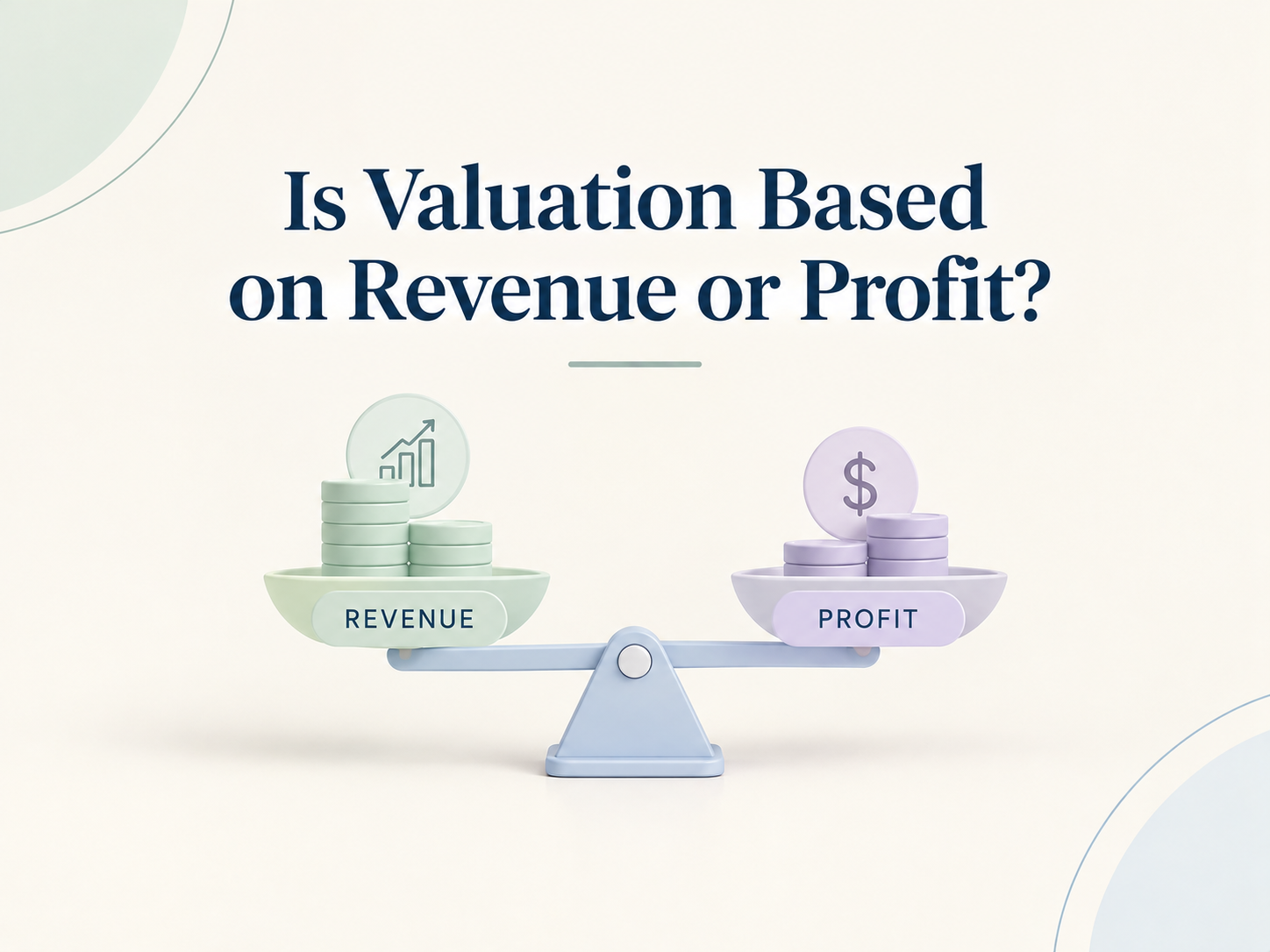
Ultimately, valuation rests on profit, or more precisely on the cash a business will generate for its owners. Revenue is a shortcut used when profit is not yet available or not yet reliable. Which measure carries more weight depends on the company's stage, its industry, and how confident investors are that sales will convert into cash.
Why Profit and Cash Flow Anchor Value
In theory, a business is worth the present value of the cash it will deliver in the future. Revenue is only the first link in that chain. A rupee of revenue is worth very little if costs absorb all of it, and a great deal if most of it reaches shareholders as free cash flow.
This is why mature, stable businesses are typically valued on earnings-based measures such as EV/EBITDA, P/E, or a discounted cash flow model. These methods look at what is left after the cost of running the business, which is what an owner or acquirer actually receives.
Why Revenue Still Matters
Revenue earns its place in valuation for a simple reason: it is the starting point for every future profit. Without sales, there is nothing to convert into earnings. It is also harder to manipulate than profit, which can be shaped by accounting choices, one-off items, and timing differences. For companies whose profit is volatile or distorted, revenue can offer a steadier reference point.
When Revenue Takes Over
Revenue multiples are common in three situations:
- Loss-making or early-stage companies. Where EBITDA is negative, an earnings multiple produces a meaningless result, so valuers fall back on EV/Revenue or EV/Gross Profit.
- High-growth businesses. Where margins are deliberately sacrificed for scale, revenue is a better indicator of the size of the opportunity than current profit.
- Businesses with recurring revenue. Subscription and SaaS companies are often valued on annual recurring revenue, because sales are predictable and margins are expected to improve as the business scales.
In each case, the valuer is making an implicit assumption: that today's revenue will eventually produce profit at a reasonable margin.
The Catch With Revenue Multiples
Revenue says nothing about efficiency. Two companies with identical sales can be worth very different amounts if one earns a 30% margin and the other loses money on every order. A revenue multiple applied without adjustment would value them the same, which is plainly wrong.
For this reason, revenue multiples are rarely applied as a flat industry average. They are adjusted for growth rate, gross margin, and how close the company is to profitability. Gross profit is often a better base than revenue because it strips out the direct cost of delivering the product and shows the underlying unit economics.
Bridging the Gap: Growth and Margin Together
Some metrics exist specifically to combine revenue and profit into a single view. The Rule of 40, for example, adds revenue growth to profit margin, so a company with 50% growth and a negative 10% margin scores the same as one with 15% growth and a 25% margin. Investors use measures like this to judge whether a company's growth is being bought at a sustainable price. A company that grows quickly while keeping margins healthy typically earns a higher multiple than one doing only one of the two.
How the Basis Changes as a Company Matures
Revenue-based valuation is best understood as a bet on future profit. A high revenue multiple only makes sense if the market believes margins will eventually rise to a level that justifies it. As the company matures, the valuation basis usually migrates in stages:
- Early stage: revenue or even user and customer metrics
- Growth stage: revenue or gross profit, cross-checked with a long-horizon DCF
- Established stage: EBITDA and operating profit
- Mature stage: earnings, P/E, and free cash flow
A company that stays on the revenue rung for too long, without showing margin improvement, tends to see its multiple compress as investors lose patience.
Common Mistakes
- Applying a revenue multiple to a business with structurally poor margins. High sales and low profitability do not support a high multiple.
- Ignoring cash conversion. Profit that never turns into cash, because it is tied up in receivables or inventory, is worth less than it appears.
- Using a peer multiple without checking comparability. Growth, margin, and size differences can make an average misleading.
- Relying on one method. A single multiple, taken at a single moment, can mislead if market sentiment is unusually high or low.
A Practical Rule of Thumb
- Profitable, stable business: value on EBITDA, earnings, or DCF.
- Growing but loss-making business: value on revenue or gross profit, cross-checked with a long-horizon DCF.
- Asset-heavy or holding company: consider net asset value.
- Any case: triangulate across more than one method rather than relying on a single measure.
Profit and cash flow determine what a business is worth. Revenue is a stand-in used where profit does not yet tell the story, and it works only when there is credible evidence that sales will turn into earnings. The most reliable valuations look at both: revenue to understand scale and momentum, and profit and cash flow to understand what that scale is actually worth.