
US Interest Rates in 2026: Impact on Private Company Valuation
Explore how U.S. interest rates in 2026 can affect private company valuations, including their impact on discount rates, financing costs, cash flows, transaction multiples, and investor expectations.
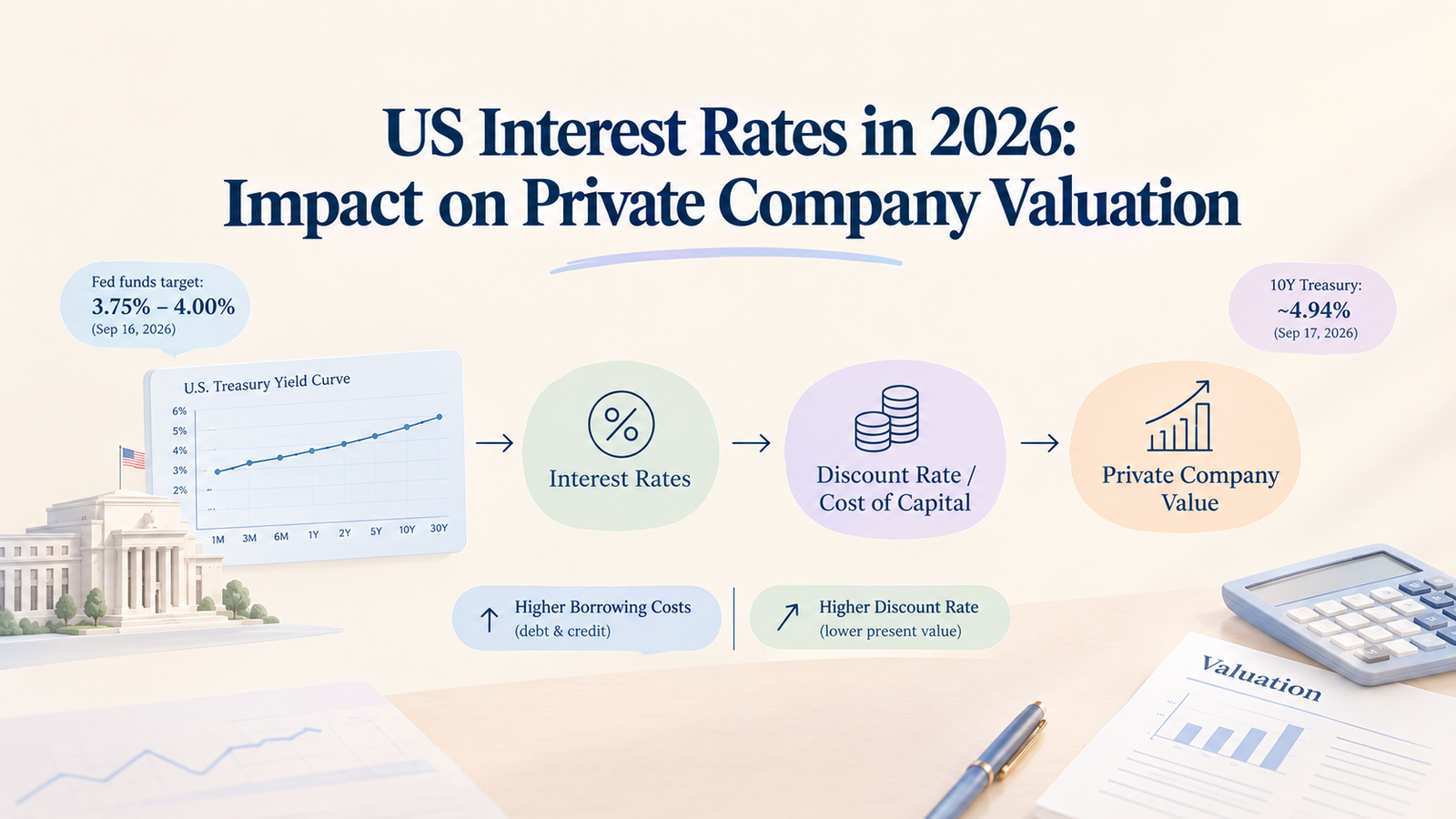
The Federal Reserve spent the second half of 2025 cutting rates, bringing the federal funds rate down to a 3.50%-3.75% range by December. Most market participants entered 2026 expecting further cuts. Instead, the Fed held steady through the first half of the year, then reversed course entirely raising rates on September 16, 2026 to 3.75%-4.00%, its first hike in more than three years, as inflation remained stubbornly above target and geopolitical tensions added further upside pressure. For anyone valuing a private company, this reversal matters far more than the headline rate move itself suggests.
Why This Reversal Matters More Than the Number
A quarter-point move might look small in isolation. What matters for valuation is the shift in expectations it represents. Companies and investors that built financial models assuming continued rate cuts through 2026 are now working with a materially different discount rate environment than they planned for at the start of the year and private company valuations, unlike public equities, don't reprice daily in response to this kind of shift. They reprice only when the next valuation is actually performed, which means the gap between assumption and reality can sit unaddressed for months.
Where Higher Rates Show Up in a DCF Valuation
The discount rate rises directly. WACC calculations typically anchor the risk-free rate component to Treasury yields, which move in tandem with Fed policy. A higher risk-free rate mechanically raises the discount rate applied to every year of projected cash flow, reducing present value even where the underlying business hasn't changed at all.
Terminal value takes the biggest hit. Since terminal value is calculated by dividing by the difference between the discount rate and the long-term growth rate, and typically represents the majority of a DCF's total value, even a modest rate increase compounds into a disproportionately large valuation impact through this single component.
Leveraged businesses face a double impact. A private company carrying meaningful floating-rate debt sees its interest expense rise directly, compressing free cash flow at the same time its discount rate is also increasing. A genuine double hit that a static valuation model can easily understate if it doesn't explicitly link financing costs to the current rate environment.
The Broader Market Effect
Private equity sponsors currently pay roughly three turns of EBITDA more than strategic corporate buyers, reflecting a large pool of accumulated capital competing for a shrinking supply of quality private assets. A gap that a higher-rate environment tends to narrow over time, since higher borrowing costs constrain how aggressively a leveraged buyer can bid without it showing up directly in their own returns.
More broadly, elevated rates for longer compress valuation multiples across private markets generally, particularly for growth-oriented businesses whose cash flows sit furthest in the future and are therefore most sensitive to the discount rate applied to them. A business with strong near-term earnings tends to weather this environment considerably better than one whose value depends heavily on a distant, uncertain payoff.
What This Means for a Valuation Prepared Today
Revisit the risk-free rate assumption explicitly, rather than carrying forward a rate used in a valuation from earlier in the year, given how meaningfully the environment has shifted since then.
Model financing costs dynamically for leveraged businesses, rather than assuming a fixed interest expense that doesn't reflect the company's actual floating-rate exposure in the current environment.
Treat terminal value assumptions with extra scrutiny, since this is precisely the component most sensitive to exactly the kind of rate shift that's just occurred.
Recognize that comparable transaction multiples from earlier in 2026 may already reflect a rate environment that no longer holds, making them a weaker anchor than they would have been just months ago.
A single Fed decision doesn't just move a headline number. It flows directly into discount rates, terminal value, financing costs, and comparable pricing across every private company valuation prepared afterward. Given how much of 2026's rate path has already surprised market expectations once, a valuation built on a static, backward-looking rate assumption is a genuinely weaker valuation than one that explicitly accounts for where policy actually stands today.