
Why Buyers and Sellers Often Disagree on REIT Valuation
Explore why buyers and sellers often disagree on REIT valuation, including differences in property assumptions, growth expectations, cap rates, cash flow outlook, and perceived market risk.
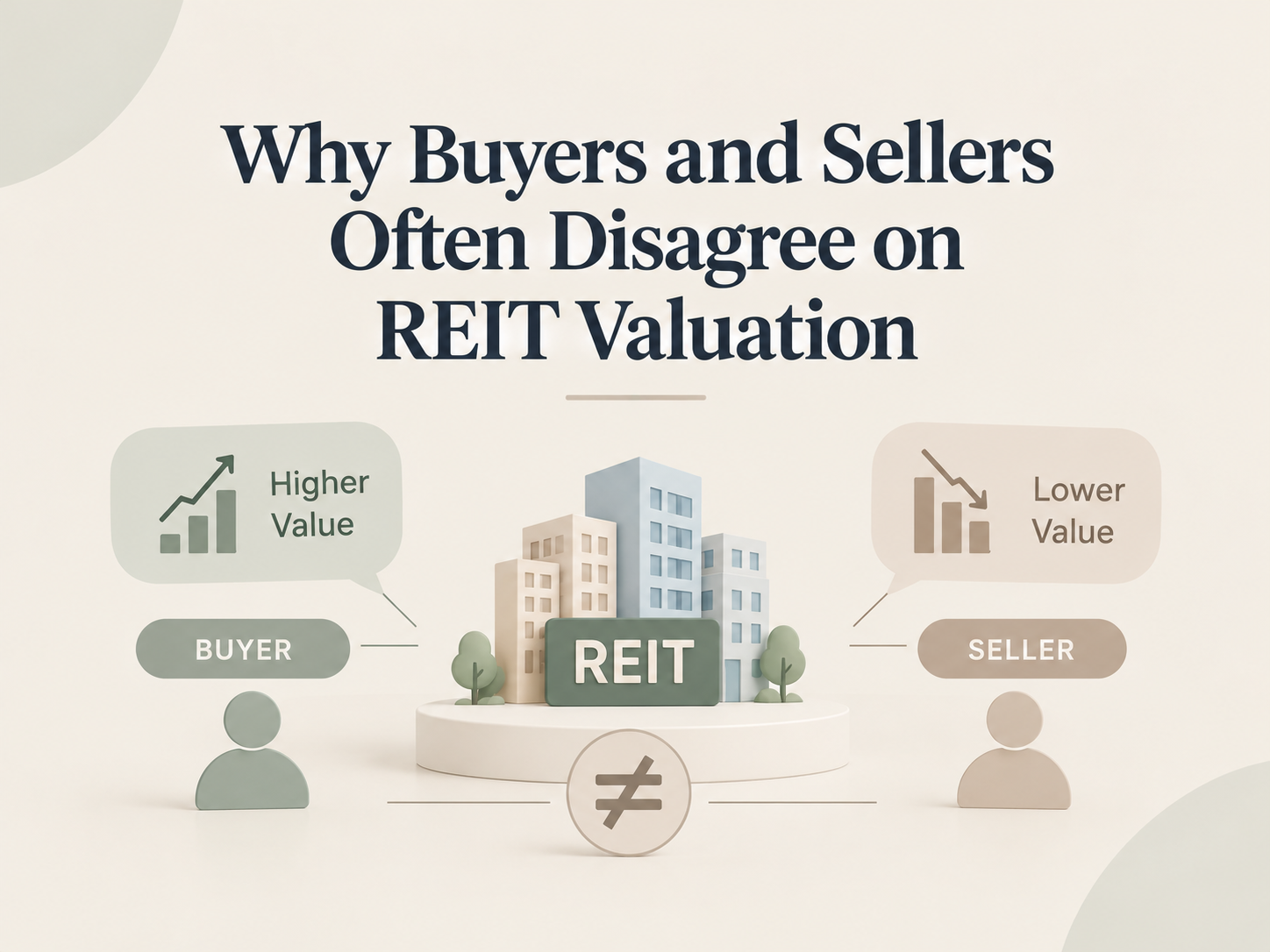
REIT valuation can become challenging when a buyer and seller assign different values to the same portfolio of properties. The disagreement does not necessarily mean that either party is using an incorrect valuation method. Buyers and sellers often make different assumptions about property income, growth, capitalization rates, market conditions, debt, and future performance.
Understanding these differences is important when evaluating a REIT, negotiating a transaction, or assessing whether the quoted price reflects the underlying value of its assets.
What Determines the Value of a REIT?
A REIT's value is closely linked to the value and income-generating potential of its underlying real estate assets.
Depending on the purpose of the valuation, analysts may consider:
- Net Asset Value (NAV)
- Capitalization rates
- Net operating income (NOI)
- Discounted cash flow (DCF)
- Comparable property transactions
- Debt and other liabilities
- Public market trading multiples
For many REITs, the key question is not simply how much the properties are worth today, but also how much income and growth they are expected to generate in the future.
Why Do Buyers and Sellers Disagree on REIT Value?
1. Different Views on Capitalization Rates
The capitalization rate, or cap rate, is one of the most important inputs in property valuation.
The basic relationship is:
Property Value = NOI ÷ Cap Rate
Suppose a property generates annual NOI of ₹10 crore.
At a 7% cap rate:
Value = ₹10 crore ÷ 7% = ₹142.9 crore
If the buyer believes a 7.5% cap rate is more appropriate:
Value = ₹10 crore ÷ 7.5% = ₹133.3 crore
The same property therefore produces substantially different values based on the assumed cap rate.
A buyer may use a higher cap rate because of perceived risks such as higher interest rates, weaker demand, property-specific risks, or future vacancies. A seller may argue for a lower cap rate based on the property's location, tenant quality, lease stability, or growth prospects.
2. Different Expectations About NOI
Net operating income is another major driver of REIT valuation. Buyers and sellers may disagree about whether current NOI is sustainable.
For example, a seller may value a property based on current occupancy and rental income, while a buyer may expect vacancies, maintenance expenses, or lease expiries to reduce future NOI. The opposite can also occur. A buyer may expect rents to increase significantly when existing leases are renewed and therefore assign greater value to the property.
This makes normalised NOI particularly important. Using an unusually high or low current-year NOI without considering sustainable future income can distort the valuation.
3. Different Views on Future Growth
REITs may own properties with opportunities for rental growth, redevelopment, expansion, or improved occupancy. A seller may place a premium on this future potential. A buyer, however, may argue that the expected growth is uncertain and should not be fully reflected in today's valuation.
For example, if a property currently generates ₹10 crore of NOI but is expected to reach ₹12 crore after lease renewals, the buyer must assess whether that increase is supported by market rents, tenant demand, and existing lease terms. The disagreement is therefore often about how much future growth should be reflected in today's value.
4. Different Views on NAV
Net Asset Value, or NAV, is commonly used to assess the value of a REIT's underlying assets after considering liabilities.
A simplified approach is:
NAV = Fair Value of Properties + Other Assets − Liabilities
However, determining the fair value of the properties can itself involve significant assumptions.
Two valuers may arrive at different property values because they use different comparable transactions, cap rates, rental growth assumptions, vacancy expectations, or valuation dates.
As a result, even when both parties use NAV, their conclusions may differ.
5. Debt Can Change the Investment Value
A REIT may own valuable properties but also carry significant debt.
Therefore, the value of the underlying real estate is not the same as the value attributable to equity holders.
For example, if a REIT's properties are valued at ₹1,000 crore and it has ₹400 crore of debt, a simplified equity value would be:
₹1,000 crore − ₹400 crore = ₹600 crore
Buyers may also have different views about future interest costs, refinancing requirements, maturity schedules, and the appropriate value of the debt.
This can create another source of disagreement.
6. Public Market Price vs Private Market Value
A listed REIT also has a market price determined by investors in the stock market. This market price may differ from the NAV of the underlying properties. Investors may apply a premium to NAV if they expect strong growth, high-quality assets, or efficient management. Conversely, the REIT may trade at a discount to NAV because of concerns about debt, interest rates, property concentration, weak growth, or broader market conditions.
Therefore, a buyer evaluating a REIT transaction should not automatically assume that its market price represents the exact fair value of its underlying assets.
A Simple Example of REIT Valuation Differences
Suppose a REIT owns properties generating ₹50 crore of annual NOI.
The seller believes a 6.5% cap rate is justified:
₹50 crore ÷ 6.5% = ₹769 crore
The buyer believes the appropriate cap rate is 7.5%:
₹50 crore ÷ 7.5% = ₹667 crore
The difference is approximately ₹102 crore.
Both parties may be using the same NOI and the same basic valuation formula. Their disagreement comes from their assessment of risk and the appropriate market yield.
This illustrates why valuation negotiations often focus heavily on assumptions rather than the formula itself.
What Should Be Considered in a REIT Valuation?
A robust REIT valuation should consider the quality and sustainability of the underlying income as well as the properties themselves. Important factors include occupancy levels, lease terms, tenant quality, rental growth, property location, operating expenses, cap rates, capital expenditure, debt, interest rates, and comparable transactions.
The valuation should also consider whether current income is sustainable and whether future growth assumptions are supported by market evidence.
How Can Buyers and Sellers Reach a More Reasonable Value?
The objective should not be to select assumptions that produce the highest or lowest valuation. Instead, both parties should understand the assumptions driving the difference. A practical approach is to compare valuations under different cap rates, rental growth assumptions, occupancy levels, and financing conditions. This sensitivity analysis can show which assumptions have the greatest impact on value.
Independent valuation can also help provide an objective assessment, particularly when the transaction involves a large or diversified property portfolio.
Conclusion
Buyers and sellers often disagree on REIT valuation because they have different expectations about income, growth, risk, cap rates, property values, and debt. The valuation formula itself is usually not the main source of disagreement. The greater challenge lies in determining which assumptions best reflect current market conditions and the future performance of the underlying assets.
A well-supported REIT valuation should therefore go beyond a single NAV or market multiple. It should examine the underlying properties, sustainable NOI, market evidence, capital structure, and future cash-flow potential.
Ultimately, the most defensible valuation is one where the assumptions are reasonable, transparent, and supported by reliable market evidence.