Loading…


Loading…
Explore the key market factors that influence D2C brand valuations in the U.S., including revenue growth, customer economics, brand strength, margins, retention, and market positioning.
The DTC bubble of 2020-2021 has fully corrected, and what's replaced it is a more disciplined, bifurcated market: strong brands still command real premiums, while mediocre ones increasingly struggle to find a buyer at any multiple. Understanding what actually separates the two has become the central question in valuing any US direct-to-consumer brand today.
The Multiple Range, and Why It's So Wide?
Current EBITDA multiples for private ecommerce and DTC companies generally range from 2.5x to 10x, with most mid-sized brands transacting between 3x and 6x, and scaled, diversified brands with strong margins reaching 6x to 10x or higher. In tax appraisals using a strategic value amount when a separate value is really needed. Or the other way around. Leads to a number that won't hold up to review. This is because these systems are usually based on the buyer- separate value idea. The idea is to prevent the number from changing depending on who's interested, in the company.
This wide spread isn't randomness. It reflects genuine differences in the underlying fundamentals buyers are actually underwriting, and closing that gap is where most of the real value in a sale process gets created.
The Factors Buyers Actually Underwrite
Trailing twelve months, not historical peak. Buyers weight the most recent twelve months heavily, since it's the strongest available predictor of near-term cash flow. A brand growing steadily tells a buyer the momentum is real; a flat brand signals the buyer will need to restart growth themselves; a declining brand puts the buyer in a defensive position from day one and each of these gets priced very differently, regardless of what the brand achieved at its historical peak.
Channel diversification. Brands selling through their own DTC site, Amazon or Walmart marketplace, and physical retail command one to two additional multiple turns over an Amazon-only brand, since diversified revenue is inherently less exposed to a single platform's policy changes or algorithm shifts. Hybrid models combining ecommerce with physical retail presence are increasingly commanding the highest multiples in the current private equity market specifically.
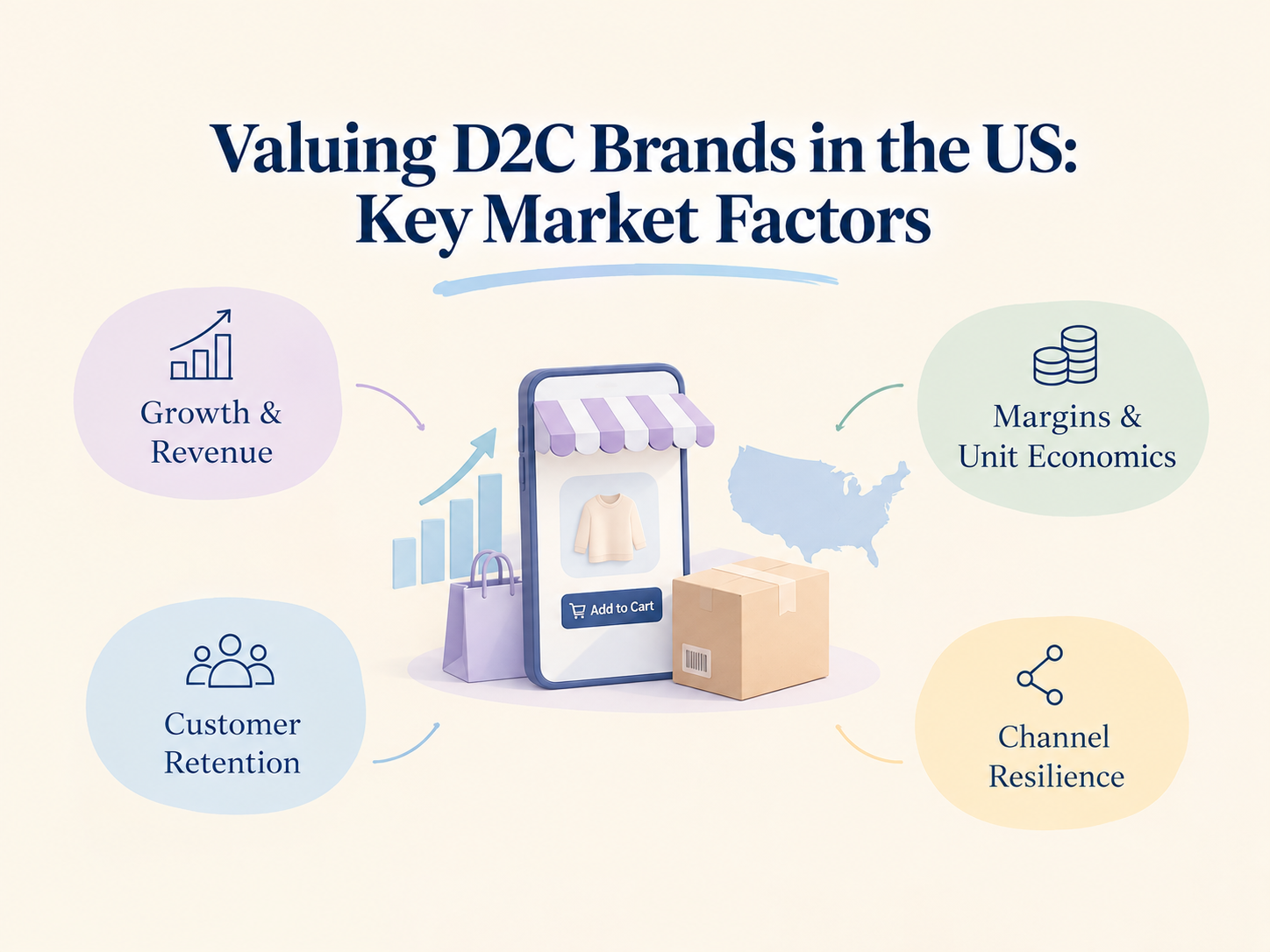
Contribution margin and unit economics over topline growth. The 2021 aggregator era rewarded growth almost regardless of profitability. That era is over. Buyers now underwrite contribution margin, retention, and channel durability first, which means a smaller, disciplined brand with real unit economics can outvalue a larger one still burning cash to grow.
Owned customer data. As third-party tracking continues to erode, a brand's own first-party customer relationships and purchase history have become a genuinely more valuable asset than they were a few years ago, since they reduce future dependence on increasingly expensive paid acquisition.
Why Buyer Type Changes the Number
The same company can get different offers based on who is making the bid. Companies that want to buy another business to add to their line of products usually offer the most money. This is because they can combine operations and save money in ways that other buyers cannot. Private equity sponsors are currently paying roughly three turns of EBITDA more than strategic buyers on average, reflecting a large pool of accumulated capital competing for a shrinking supply of quality assets. Aggregators, the dominant buyer type during the 2021 boom, remain active but at a much smaller scale and with far stricter acquisition criteria than during that earlier cycle.
Running a fair process where several qualified buyers are competing with each other is what regularly pushes a brand from the bottom of its multiple range to the top. This has impact, than any single financial metric alone.
The Preparation Window That Actually Moves the Multiple
Most multiple expansion happens in the twelve to eighteen months before a sale process begins, not during the process itself. Clean, well-documented financials, clearly written standard operating procedures, demonstrated channel diversification, and a credible growth trajectory are what let a brand argue for a premium multiple with real evidence, rather than simply asserting it.
DTC valuation in the U.S. Has shifted decisively. It has moved away from pricing that focuses on growth at any cost. Instead the new approach is disciplined, putting fundamentals first. In this market the gap, between a fair multiple and a strong multiple is won well before a sale process ever starts. Brands that can document contribution margin quality, channel durability, and owned customer relationships are the ones capturing premium value in 2026, regardless of how large or small they are.