Loading…


Loading…
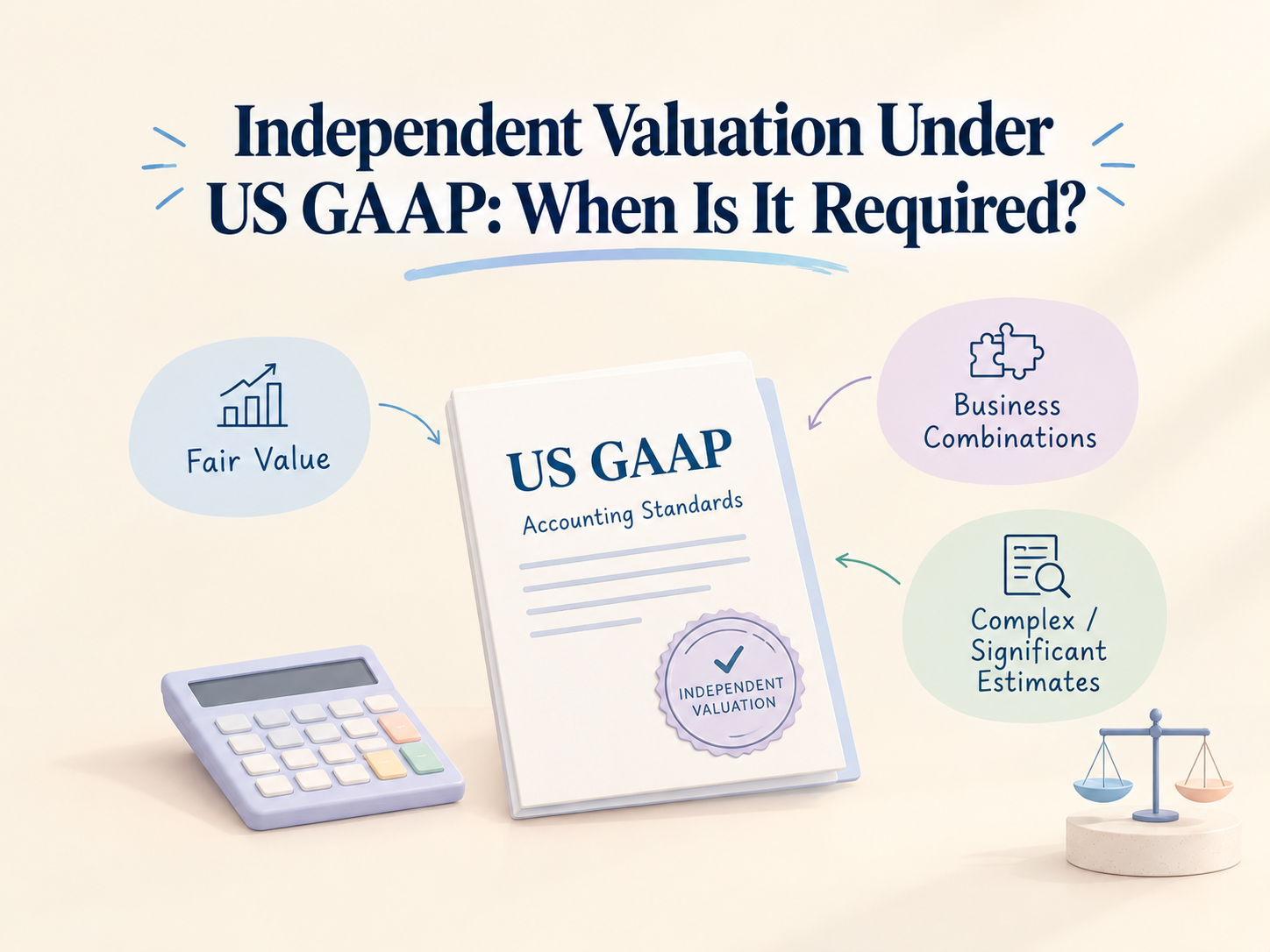
Understand when US GAAP may require or support an independent valuation, including key financial reporting situations, valuation requirements, and the role of third-party valuation professionals.
US GAAP does not contain a blanket rule requiring every fair value measurement to be performed by an outside firm. Management is generally permitted to prepare its own estimates. In practice, several recurring situations create enough audit, regulatory, and reputational exposure that an independent valuation becomes the practical standard, even where it isn't strictly mandated by the accounting rules themselves.
Business Combinations Under ASC 805
Any acquisition requires a Purchase Price Allocation, assigning fair value to every identifiable asset and liability acquired, including intangibles that never appeared on the target's own balance sheet i.e. customer relationships, trademarks, developed technology. Because these valuations directly determine reported goodwill and amortization for years afterward, auditors typically expect an independent specialist's involvement for any acquisition of meaningful size, and often engage their own specialist to test management's figures regardless.
Goodwill and Long-Lived Asset Impairment Under ASC 350 and ASC 360
Annual goodwill impairment testing, and any long-lived asset impairment triggered by a decline in performance, requires a fair value determination for the reporting unit or asset in question. Management can perform this internally, but a company with prior impairment history, a recent decline in market capitalization relative to book value, or a complex reporting structure is far more likely to face auditor pushback on an internal analysis, making an independent valuation the more defensible path.
Stock-Based Compensation Under ASC 718
For a private company issuing stock options, the underlying common stock's fair value must be established at each grant date. While not legally mandatory, obtaining an independent appraisal is the standard way to establish the safe harbour presumption of reasonableness under Section 409A ,shifting the burden onto the IRS to prove a valuation was unreasonable, rather than leaving the company to defend it after the fact. Since 409A failures hit employees rather than the company, most private companies treat an independent valuation as effectively mandatory here.
Complex Financial Instruments Under ASC 820
Level 3 fair value measurements. Instruments that are valued using inputs that cannot be observed such, as embedded derivatives or illiquid securities. Face the scrutiny under the ASC 820 hierarchy. Auditors expect these to be supported by rigorous, well-documented models, and an independent specialist substantially strengthens a company's position when these figures are challenged in an audit or SEC review.
Contingent Consideration and Earnouts
Where an acquisition includes contingent consideration tied to future milestones, that liability or asset must be valued at fair value both at acquisition and every subsequent reporting date. These valuations often involve Monte Carlo simulations, and the need for repeated remeasurement, not a one-time calculation, is exactly why companies engage independent specialists to maintain consistency over time.
Related-Party and Non-Arm's-Length Transactions
Any transaction between parties. Such as an acquisition from an entity under common control a related-party loan or a transfer, between affiliated companies. Draws close attention. This is because there is a conflict when an interested party is involved in setting its own fair value. An independent valuation here serves a function beyond compliance: it provides an objective data point that the transaction was genuinely conducted on arm's-length terms.
Why Independence Matters Even Where It Isn't Strictly Required?
An internally prepared valuation is not inherently unreliable, but it inevitably faces a higher level of scrutiny, precisely because the preparer has an economic interest in the outcome. An independent valuation firm brings no comparable stake in the final number, which is exactly why auditors, tax authorities, and courts consistently give more weight to a well-documented independent report than to an internally prepared one addressing the same question.
US GAAP rarely commands an independent valuation outright. What it does is create enough downstream audit risk, tax exposure, and regulatory scrutiny around certain fair value measurements that engaging an independent specialist becomes the practical, and often the only genuinely defensible, choice. Companies facing a business combination, an impairment test, a stock option grant, or a related-party transaction are generally better served treating an independent valuation as standard practice rather than an optional safeguard.