
FCFE vs. FCFF: Key Differences in Equity Valuation
Understand the key differences between FCFE and FCFF, including their cash flow components, discount rates, valuation approaches, and when each method is appropriate for equity and business valuation.
Every DCF valuation discounts some version of free cash flow, but "free cash flow" isn't a single, universal number — it comes in two genuinely different flavors, each discounted at a different rate, each answering a slightly different question, and mismatching the two is one of the most common technical errors in practical DCF work.
What Each One Actually Measures
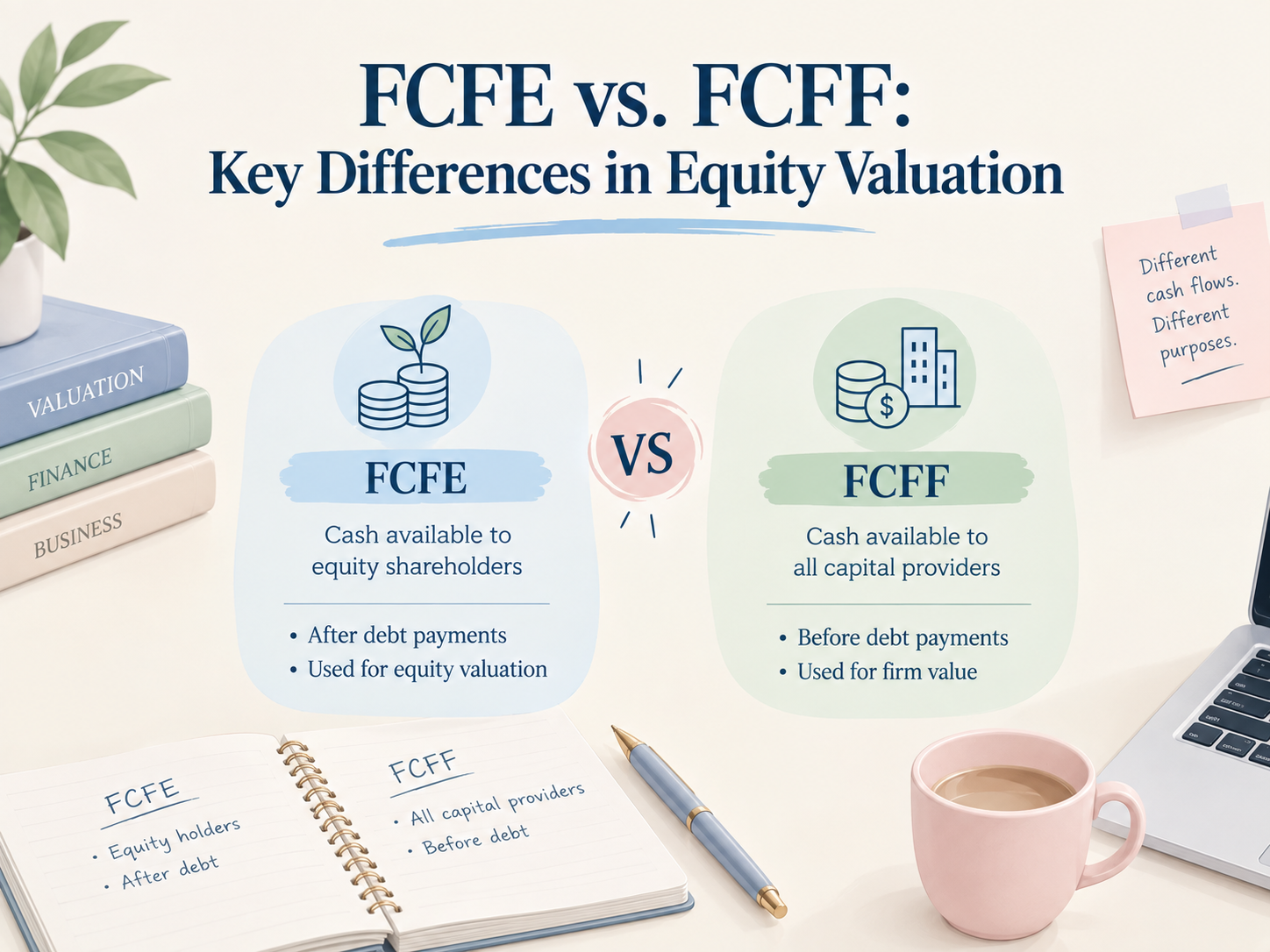
Free Cash Flow to the Firm (FCFF) represents the cash available to all capital providers — both debt and equity holders — before any financing effects. It's typically calculated starting from EBIT, adjusted for tax, adding back depreciation and amortization, then subtracting capital expenditure and the increase in net working capital. Critically, FCFF is calculated before interest expense, since it represents cash available to service all capital, not just equity.
Free Cash Flow to Equity (FCFE) represents the cash available specifically to equity holders, after all obligations to debt holders have already been met. It starts from FCFF and subtracts after-tax interest expense, then adds back net new borrowing (or subtracts net debt repayment) — capturing the actual cash flow equity holders could receive after the company has serviced and adjusted its debt position for the period.
Why the Discount Rate Must Match
This is where the two methods most commonly get confused, and it's a genuinely consequential error. FCFF, since it represents cash available to all capital providers, must be discounted using WACC — a rate blending the cost of both debt and equity. FCFF discounted at WACC produces enterprise value, from which net debt must still be subtracted to arrive at equity value.
FCFE, since it already reflects cash flow after debt holders have been paid, must be discounted using cost of equity alone, not WACC. FCFE discounted at cost of equity produces equity value directly, with no further adjustment for debt required.
Discounting FCFF using cost of equity, or FCFE using WACC, is a mismatch that produces a materially wrong valuation — not a minor rounding difference, but a genuine methodological error that compounds across the entire projection period.
When Each Approach Is the Better Choice
FCFF is generally preferred for companies with complex, changing, or highly leveraged capital structures. Since FCFF is calculated before financing effects, it's less distorted by a company's specific debt level or by leverage that's expected to change meaningfully during the projection period — useful for a leveraged buyout target, or a company actively deleveraging following a large acquisition.
FCFE is often more intuitive and direct where a company's capital structure is genuinely stable. Since FCFE goes straight to equity value without the intermediate step of calculating enterprise value and subtracting debt, it can be a cleaner approach for a company with a simple, unchanging debt profile — though this same directness becomes a liability if debt levels are actually expected to shift, since FCFE is more sensitive to financing assumptions embedded directly in the cash flow itself.
Banks and financial institutions are typically valued using FCFE, not FCFF, since debt for a lender isn't a financing choice sitting apart from operations — it's the raw material of the business itself, making the FCFF concept of "cash flow before financing effects" difficult to apply meaningfully.
A Common, Costly Mistake
A frequent error in practice is building a cash flow model that blends elements of both approaches without full consistency — for instance, calculating a cash flow figure that includes some financing effects (like actual interest expense) while still discounting it at WACC as though it were a pure FCFF calculation. This hybrid, internally inconsistent approach produces a valuation that doesn't correspond cleanly to either method's underlying logic, and is considerably harder to defend under scrutiny than a valuation built cleanly around one approach or the other from the start.
FCFF and FCFE aren't interchangeable labels for the same underlying number — they represent genuinely different cash flow concepts, requiring genuinely different discount rates, and producing results through different paths to the same ultimate destination of equity value. Choosing the right one for a given company's capital structure, and discounting it with the rate that actually matches, is a foundational discipline that a more sophisticated valuation model can't compensate for if this basic pairing is wrong.