Loading…


Loading…
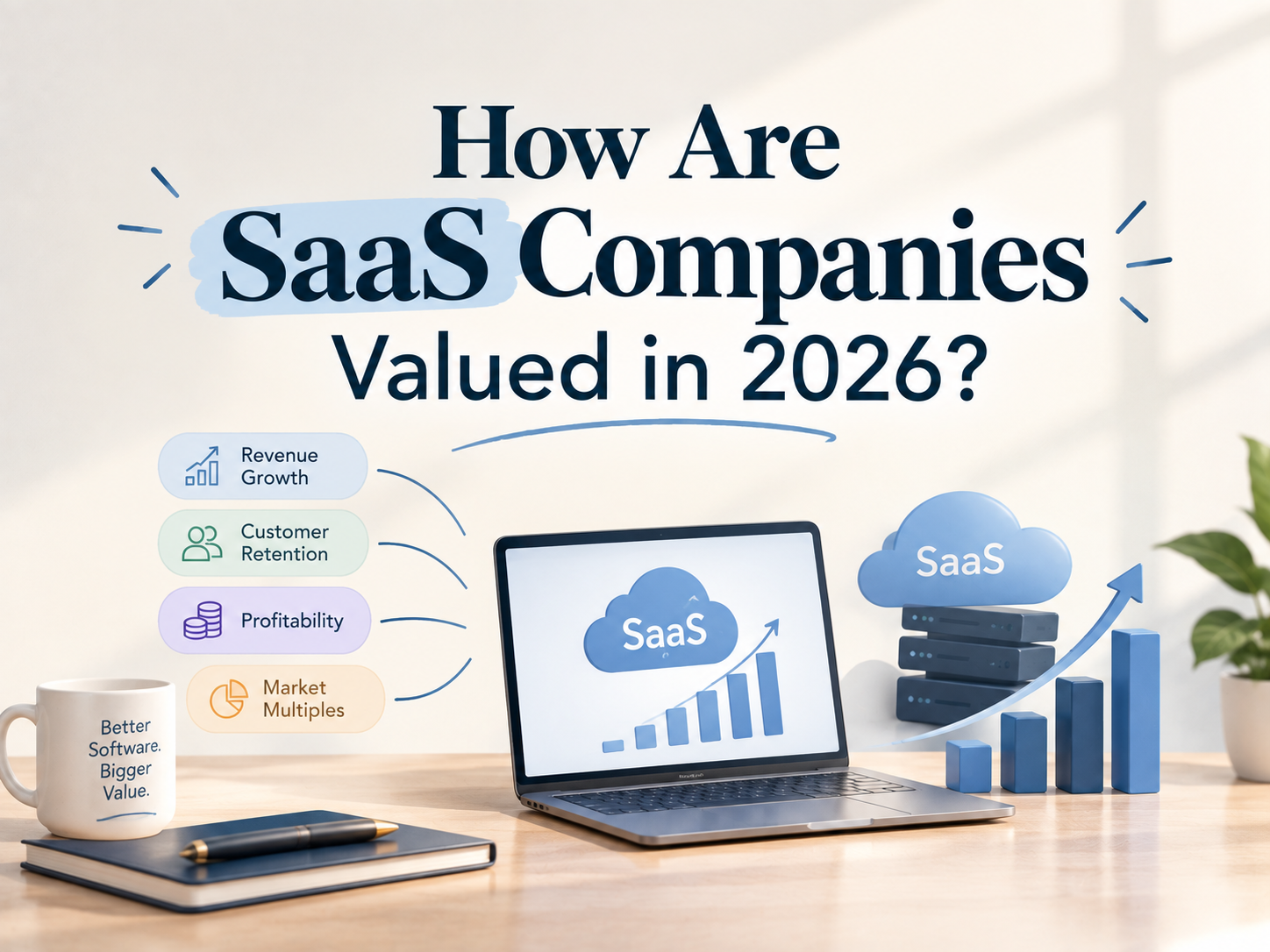
Discover how SaaS companies are valued in 2026, including key revenue multiples, growth metrics, retention, profitability, and the factors shaping investor valuations.
SaaS valuations have shifted considerably over the past several years, and 2026 has introduced a new set of considerations. The elevated multiples of 2021 have given way to a more measured environment, and investors are now weighing a critical question: will artificial intelligence strengthen the SaaS business model, or gradually erode it? This piece outlines how SaaS companies are currently being valued, and what factors are driving those valuations.
For much of the past decade, SaaS valuation centered on a single metric: the revenue multiple. Companies were commonly valued at a set multiple of Annual Recurring Revenue (ARR) often 8x to 10x with limited regard for underlying profitability.
That approach has largely given way to more disciplined pricing. SaaS valuations reached decade-plus lows in early 2026, as markets responded to growing concern that AI could pose a structural threat to the traditional SaaS model. Public SaaS companies currently trade in a considerably narrower range, roughly 6x to 7x revenue, with top-performing companies trading well above that band and underperforming companies falling well below it.
Private companies typically trade at a discount to their public counterparts, often in the range of 30% to 50%. As a result, many small- and mid-sized SaaS businesses fall within a 3x to 6x ARR range, with only a limited number of high-performing companies reaching double-digit multiples.
The metric that drives valuation now is not rapid growth alone to command a premium multiple. In 2026, buyers are evaluating growth and profitability in tandem, rather than treating growth as the primary determinant of value.
Several metrics have become increasingly influential:
In effect, the market has shifted its emphasis from scale and velocity toward sustainability and operational discipline.
The Role of Artificial Intelligence
Artificial intelligence remains the most significant variable influencing SaaS valuations this year, and its effect is bidirectional.
On one hand, concern that AI could make it easier to replicate or displace traditional SaaS products has contributed to downward pressure on valuations across the sector. On the other hand, companies that can demonstrate measurable AI-driven improvements,stronger retention, reduced churn, or meaningful product enhancement are commanding notable premiums, particularly when AI is central to the product rather than a peripheral feature.
Analysts are increasingly distinguishing between companies building genuine AI-driven value and those positioning AI primarily as a marketing narrative. This distinction is becoming a meaningful factor in how companies are priced.
Common Valuation Methodologies
Several established methodologies continue to inform SaaS valuations in 2026:
For early-stage, pre-revenue SaaS companies, valuation is considerably more qualitative. In the absence of meaningful revenue, investors typically assess team strength, market size, and early indicators of product-market fit.
Valuing a SaaS company in 2026 requires more than identifying the highest growth rate. It requires demonstrating durability through customer retention, sound margins, and a substantiated, rather than purely promotional, AI strategy. While multiples have declined from their pandemic-era peaks, well-managed SaaS companies continue to command meaningful premiums. The disparity between average and top-tier SaaS businesses has arguably never been more pronounced, underscoring the importance of understanding the underlying drivers of valuation for founders, investors, and acquirers alike.