
How M&A Trends Affect US Business Valuations

Explore how M&A trends influence U.S. business valuations, including deal activity, buyer demand, transaction multiples, financing conditions, and the factors shaping acquisition pricing.
M&A activity doesn't just reflect the state of the economy, it actively sets the price tag on every business watching from the sidelines. When deal volume rises and strategic buyers compete for quality assets, valuations across an entire sector tend to climb with them. Understanding where the current M&A cycle stands helps explain why a company might be worth more, or less, than it would have been just a year or two ago.
Where the Market Stands Right Now
US dealmaking is in a genuine upswing. After 2025 closed with the highest volume of M&A activity since 2021, US M&A volumes surged 52% year-over-year to roughly $2.5 trillion, with mega-deals above $5 billion accounting for 55% of total value. That momentum has carried into 2026, with transactions valued at $100 million or more increasing 58% in value and 21% in volume from the prior year between May and July. Total deal value rose from $480 billion in 2025 to $640 billion in 2026, a 33% increase, making this the strongest rebound since the 2021 peak. This isn't a uniform recovery, though, and the unevenness itself carries real valuation consequences.
Why Rate Policy Moves the Multiple
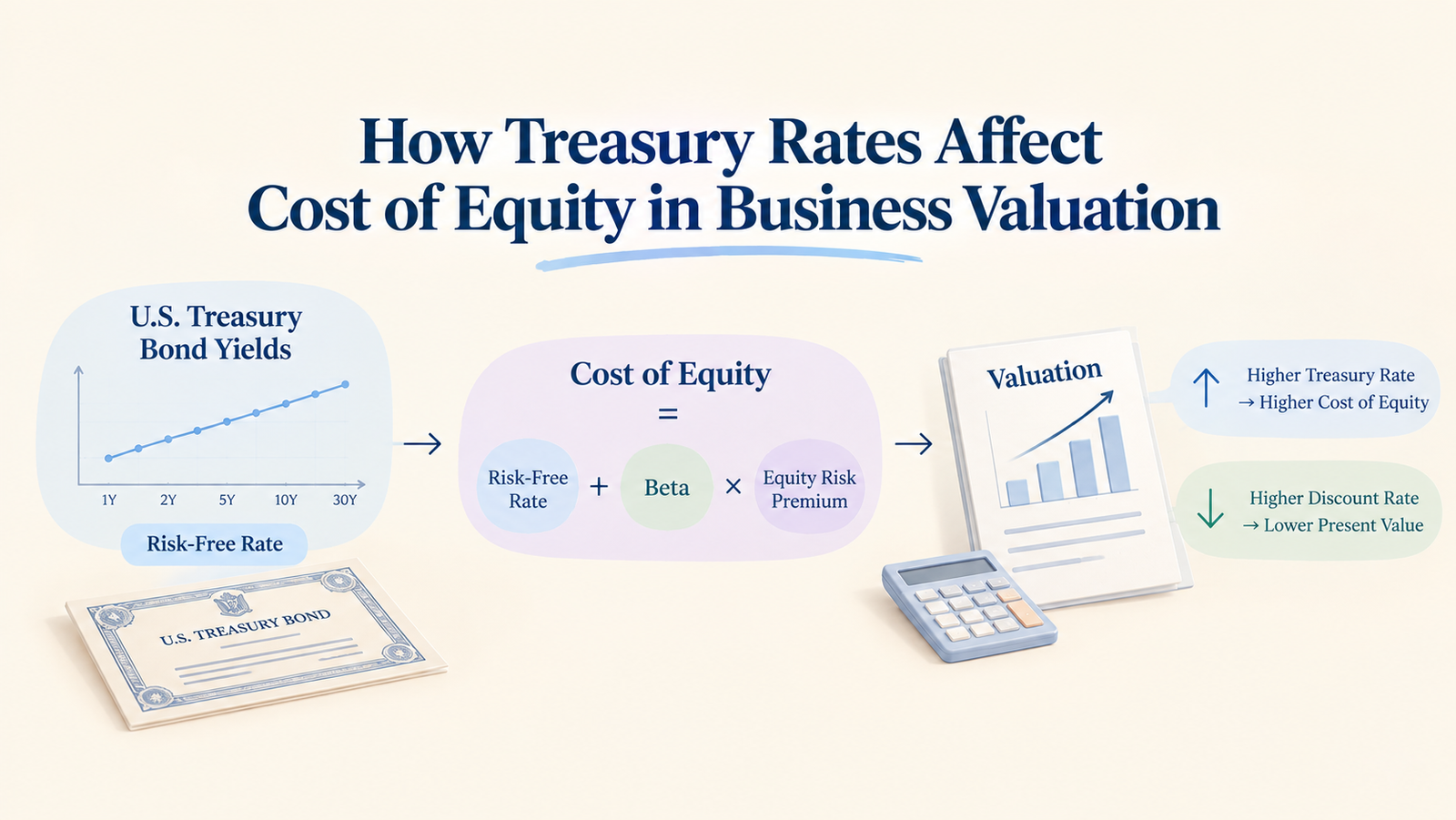
Financing cost sits underneath nearly every valuation model, whether the method being used is a DCF, a comparable company multiple, or a precedent transaction analysis. The US economy shifted into a rate-cutting environment after the Federal Reserve lowered rates three times in late 2025. Lower rates reduce the cost of acquisition debt, which allows buyers to pay more for the same cash flow stream without changing their required return. As financing conditions loosen, the multiples buyers are willing to offer tend to expand in parallel, which is part of why valuation benchmarks shift even when a target company's own fundamentals haven't changed at all.
A Divided Market: Corporates Up, Private Equity Cautious
One of the clearest signals in 2026 is the gap between strategic and financial buyers. Early 2026 data shows corporate M&A surging 22% year-over-year in the first quarter, while private equity volume declined 11% as sponsors grew more selective. This has been described as a K-shaped recovery favoring US-led, technology-heavy megadeals, with deal values rising sharply on the back of AI investment.
This divergence matters for valuation because the two buyer types price assets differently. Strategic acquirers often pay for synergies and competitive positioning that only make sense within their own existing operations, while private equity sponsors tend to anchor more tightly to a target's standalone cash flow. A market tilted toward corporate buyers therefore tends to support richer multiples, particularly for businesses with clear strategic value to an acquirer rather than purely attractive stand-alone economics.
Private equity isn't sitting entirely on the sidelines, however. US dry powder remains near $2 trillion, and slower fundraising is increasing pressure on sponsors to deploy capital and exit aging portfolio companies. That pressure can eventually push sponsors back toward more aggressive bidding, especially for the kind of high-quality, durable-earnings assets everyone in the market is currently competing over.
Sector Concentration Is Reshaping Where the Value Sits
M&A premiums aren't spreading evenly across the economy, and treating "the M&A market" as a single uniform environment misses most of the actual story. Technology delivered $150.4 billion in deal value in 2026, up 31% year-over-year, driven by AI-related consolidation and data center activity. Consumer products and retail reached $76.7 billion, up 181%, while power and utilities posted $50.5 billion, up a striking 1,269%, fueled by AI-driven demand for resilient power. Life sciences recorded $43.7 billion in deal value, up 161% amid biotech and medtech integration.
For a business owner or investor, this concentration means industry context matters enormously when interpreting national M&A statistics. A software company and a traditional retailer are effectively operating in different deal environments right now, even though both technically sit under the same headline numbers.
What's Driving the Activity Underneath the Numbers
The broader economic backdrop has been described as continuing to expand at a moderate pace, supported by resilient consumer spending and AI-driven business investment, with inflation cooling and labor market conditions remaining stable. This reflects a market where M&A is increasingly used as a deliberate, strategy-led lever to acquire capabilities and strengthen long-term competitive positioning, rather than broad-based opportunistic buying.
That shift matters for valuation in a fairly direct way. Strategy-led, capability-driven acquisitions tend to command different premiums than opportunistic bargain-hunting, since buyers in this environment are paying for something specific they can't easily build or replicate on their own.
Discipline Still Runs Through the Recovery
Despite the growth, this isn't an undisciplined boom. Deal activity has stayed selective, with corporates and financial sponsors focused on businesses with durable earnings, strong market positioning, and clear strategic fit, alongside longer diligence timelines and a greater emphasis on earnings visibility before a deal is signed. Mid-market dealmakers describe the environment as moving from recalibration toward constructive activity, but with an outlook that remains cautiously constructive rather than unreservedly bullish.
This discipline means strong valuations are increasingly concentrated on businesses that can actually demonstrate durable, visible earnings, rather than lifting the entire market indiscriminately the way a pure liquidity-driven boom might.
Rising M&A volume generally supports higher valuations, through more comparable transactions to reference, more competitive bidding among buyers, and lower financing costs that let acquirers pay more for the same cash flow. But the benefit isn't evenly distributed across every business. A company's valuation today is shaped heavily by which sector it sits in, whether it fits the profile of durable earnings and strategic fit that buyers are currently prioritizing, and whether the relevant buyer pool for that business leans toward strategic acquirers or private equity sponsors. The current cycle is expanding, but it's a selective expansion, and understanding where a given business sits within that selectivity matters more than knowing the headline growth figure alone.