
How Tax Amortization Benefit Impacts PPA Valuation
Understand how Tax Amortization Benefit (TAB) affects Purchase Price Allocation (PPA) valuation, including its impact on intangible asset values, deferred tax considerations, and overall transaction value.
Two otherwise identical intangible assets can have different fair values depending on whether the buyer can claim tax deductions for the asset after an acquisition. This is where the Tax Amortization Benefit (TAB) becomes important.
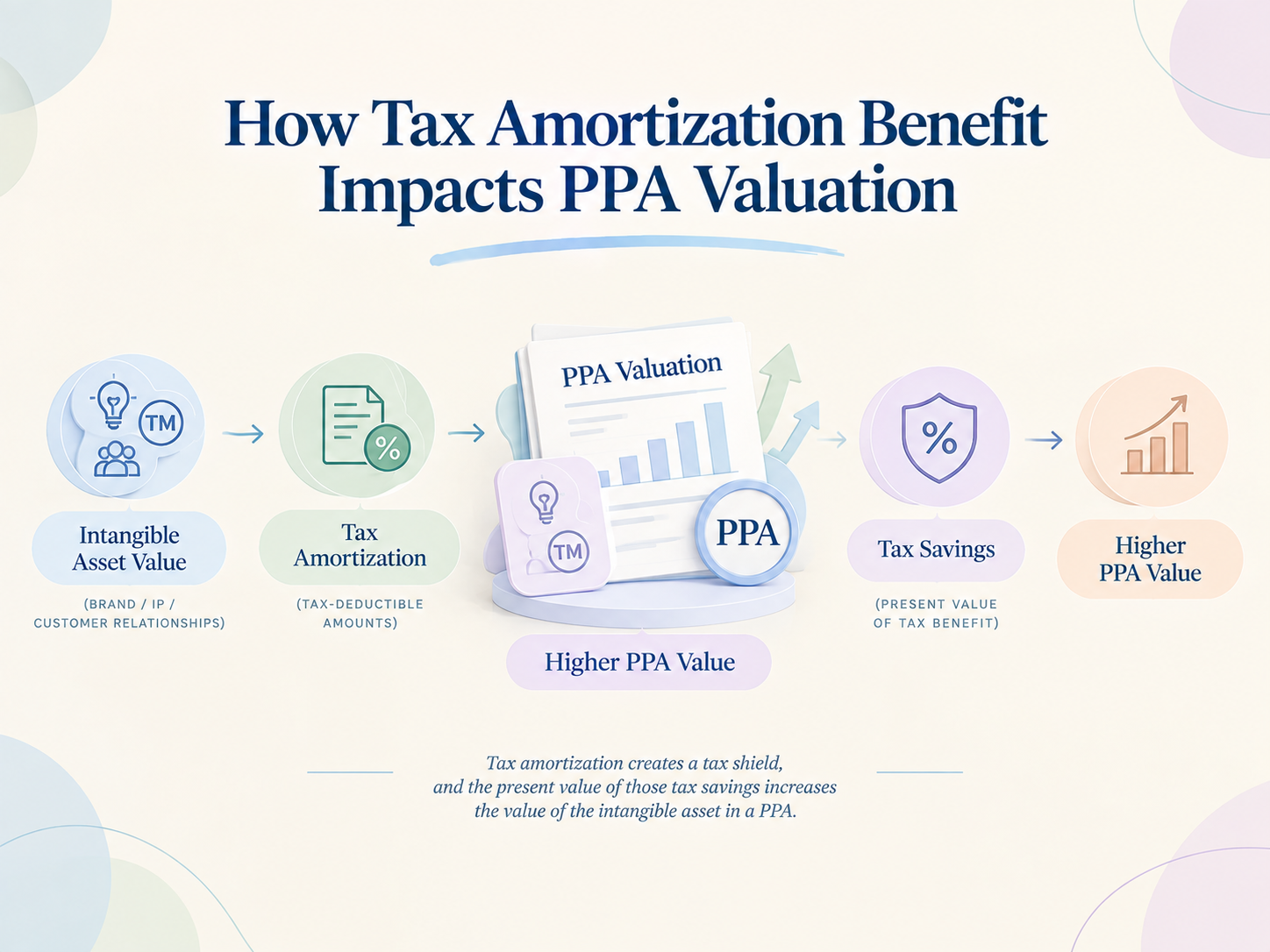
In a Purchase Price Allocation (PPA), TAB can have a meaningful impact on the fair value assigned to acquired intangible assets such as customer relationships, trademarks, patents, and developed technology. If the tax benefit is available but left out of the valuation, the resulting fair value may be understated.
What Is the Tax Amortization Benefit?
The Tax Amortization Benefit (TAB) represents the present value of the future tax savings generated when a buyer can amortize the tax basis of an acquired intangible asset.
For example, when an intangible asset is acquired in a transaction that creates a new tax basis, the buyer may be able to deduct the asset's tax basis over a specified period. In the United States, qualifying acquired intangible assets under Section 197 are generally amortized over 15 years.
Those deductions reduce taxable income and therefore create future cash tax savings. A hypothetical market participant would consider those savings when determining how much it would pay for the asset.
As a result, the value of an intangible asset with an available tax amortization benefit can be higher than the value of the same asset without that benefit.
Why Does TAB Matter in Purchase Price Allocation?
Under ASC 805 and Ind AS 103, identifiable intangible assets acquired in a business combination are generally recognised at fair value as of the acquisition date.
Fair value is based on a market participant perspective. This means the valuation should consider the economic benefits that a typical market participant would expect to receive from owning the asset.
If a buyer can deduct the cost of an acquired intangible asset for tax purposes, those future tax savings represent an economic benefit. Ignoring them can result in an incomplete valuation of the asset.
TAB can therefore affect the allocation of the purchase price between:
- Identifiable intangible assets
- Tangible assets
- Liabilities
- Deferred tax balances
- Residual goodwill
This makes TAB an important consideration in PPA valuation and intangible asset valuation.
How Is TAB Calculated?
The calculation of TAB generally involves estimating the present value of the future tax deductions associated with the asset.
A commonly used formulation is:
TAB = (Asset Value Without TAB × Tax Rate × PV Annuity Factor) ÷ (1 − Tax Rate × PV Annuity Factor)
The present value annuity factor depends primarily on:
- The applicable tax amortization period
- The discount rate
- The applicable tax rate
The calculation is somewhat circular because the TAB increases the value of the intangible asset, while the higher asset value also increases the amount of tax amortization available to the buyer.
In practice, valuation models may use an iterative calculation or an equivalent closed-form approach to arrive at the appropriate TAB.
Key Factors That Affect the Tax Amortization Benefit
Several assumptions can materially change the value of TAB.
1. Tax Rate
The tax rate directly affects the value of the future deductions.
A higher tax rate generally produces greater tax savings from amortization and therefore a higher TAB.
The relevant tax rate should reflect the tax circumstances applicable to the market participant rather than simply using an arbitrary rate.
2. Discount Rate
The future tax deductions need to be discounted back to their present value.
A higher discount rate reduces the present value of those future tax savings and therefore generally results in a lower TAB.
The discount rate should be consistent with the risk associated with the underlying intangible asset and the valuation methodology being applied.
3. Tax Amortization Period
The length of the tax amortization period also affects the benefit.
A shorter amortization period generally means that tax deductions are received sooner, increasing their present value. A longer period spreads the deductions over a greater number of years and can reduce their present value.
4. Jurisdiction
Tax rules vary significantly between jurisdictions.
In the United States, Section 197 generally provides a 15-year amortization period for qualifying acquired intangible assets. Other countries may have different tax treatment, shorter or longer amortization periods, or no comparable tax deduction at all.
Therefore, a US-style TAB assumption should not automatically be applied to an international transaction.
The valuation should first establish whether the transaction actually creates an amortizable tax basis under the applicable local tax rules.
When Should TAB Be Included in a PPA?
TAB should not simply be added to every intangible asset as a standard valuation adjustment.
The first question is whether the transaction actually gives the buyer a new tax basis that can be amortized.
For example, certain US transaction structures can result in a tax basis step-up. A transaction involving a Section 338(h)(10) election may create circumstances in which acquired intangible assets receive a new tax basis for tax purposes.
By contrast, a stock acquisition without an applicable tax basis step-up may leave the target's existing tax basis unchanged. In that situation, the buyer may not receive the same future amortization deductions.
Applying TAB without considering the actual transaction structure can therefore overstate the fair value of the acquired intangible assets.
TAB and Different Types of Intangible Assets
TAB can potentially affect the valuation of various identifiable intangible assets, including:
- Customer relationships
- Developed technology
- Trade names and trademarks
- Patents
- Non-compete agreements
- Copyrights
- Other identifiable intangible assets
However, the tax treatment should be evaluated for the specific transaction and asset rather than assumed to be identical across all intangible assets.
The useful life used for financial reporting and the tax amortization period may also differ. These differences need to be incorporated appropriately into the PPA analysis.
TAB Under ASC 805 and Ind AS 103
Both ASC 805 and Ind AS 103 require identifiable intangible assets acquired in a business combination to be measured at fair value.
The treatment of TAB, however, depends on the tax environment and transaction structure.
For US transactions, tax amortization can be particularly important because of the established rules governing qualifying acquired intangibles. For transactions outside the US, the valuation professional needs to consider the applicable local tax legislation before determining whether a tax amortization benefit exists.
This distinction is particularly important for multinational acquisitions and cross-border purchase price allocation exercises.
Common TAB Valuation Mistakes
Several issues can lead to an inappropriate TAB adjustment in a PPA.
Applying TAB Automatically
Not every acquisition creates a new amortizable tax basis. The transaction structure should be reviewed before TAB is included.
Using the Wrong Tax Rate
The tax rate should reflect the relevant tax environment and market participant assumptions rather than an unsupported generic percentage.
Ignoring the Tax Amortization Period
The timing of tax deductions affects their present value. Using an incorrect amortization period can materially change the calculated TAB.
Using an Inconsistent Discount Rate
The discount rate used for the tax benefit should be consistent with the overall valuation framework and the risk associated with the asset.
Applying US Tax Rules to Other Jurisdictions
Tax amortization rules differ between countries. A US-based assumption should not be transferred to an international PPA without confirming the applicable tax treatment.
Why TAB Matters in Intangible Asset Valuation
The Tax Amortization Benefit is more than a mechanical adjustment in a purchase price allocation. It represents an economic benefit that may be available to a market participant acquiring an intangible asset.When the transaction creates an amortizable tax basis, the resulting tax deductions can generate meaningful future cash tax savings. Those savings can increase the fair value of the acquired intangible asset.At the same time, TAB should only be included when the underlying tax and transaction circumstances support it.
The Tax Amortization Benefit (TAB) can have a significant impact on the fair value of intangible assets in a Purchase Price Allocation.The calculation generally depends on the applicable tax rate, discount rate, tax amortization period, and transaction structure. Most importantly, the valuation needs to establish whether the buyer actually receives an amortizable tax basis in the first place.For ASC 805 and Ind AS 103 valuations, properly assessing TAB helps ensure that identifiable intangible assets are valued from a market participant perspective and that the resulting PPA is supported by the underlying economics of the transaction.TAB should therefore be treated as a transaction-specific valuation consideration—not as an automatic adjustment applied to every acquired intangible asset.