Loading…


Loading…
Learn how the Relief-from-Royalty Method values intangible assets by estimating the royalties a business would save by owning the asset, with key inputs, assumptions, and valuation considerations.
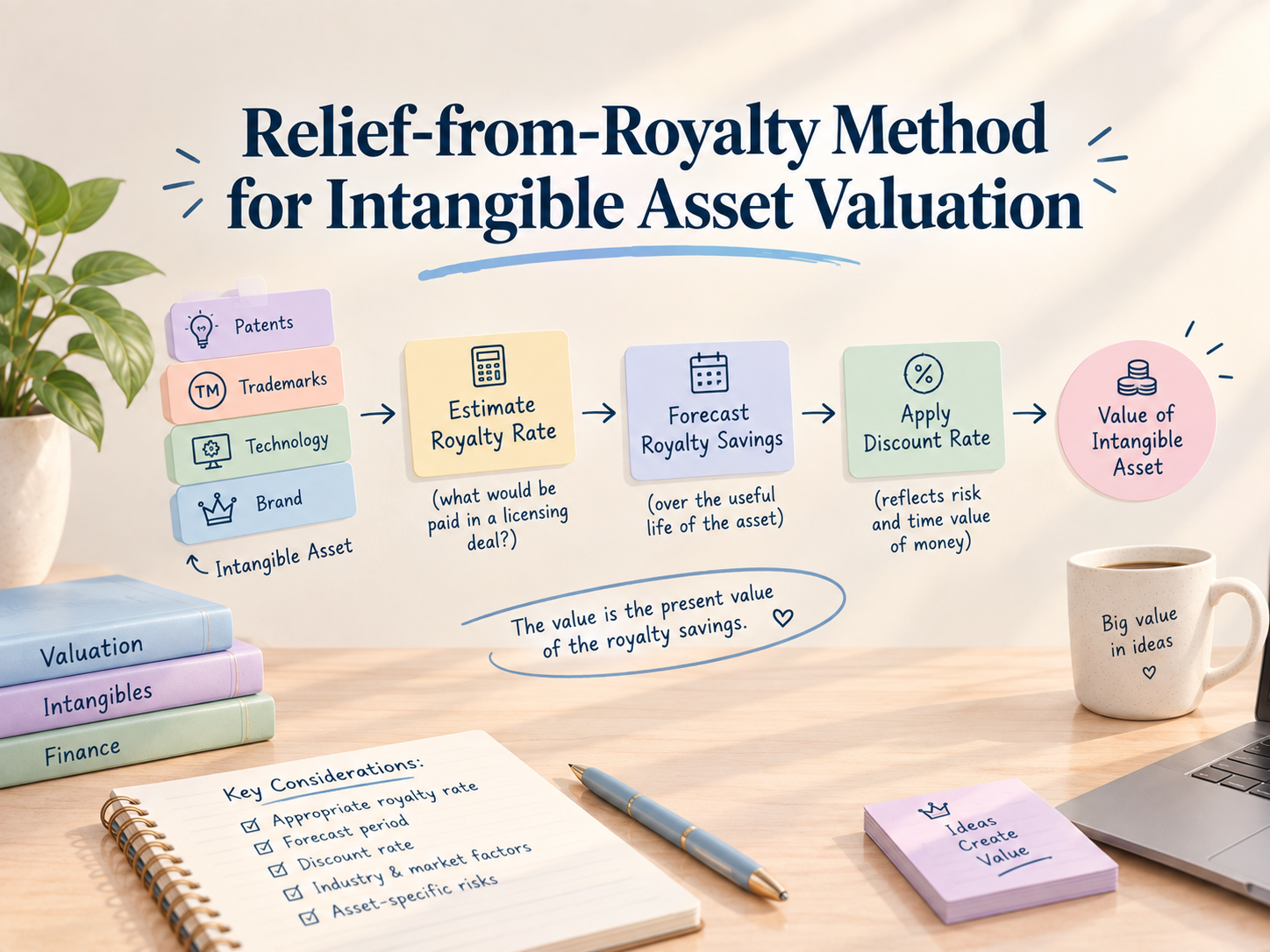
A company that owns its own brand doesn't pay anyone to use it — but that doesn't mean the brand has no measurable value. The Relief-from-Royalty method values it by asking a simple question: what would this company have to pay in royalties if it didn't own the brand, and had to license it from someone else instead? The royalty payments it's "relieved" from making, discounted back to today, become the brand's estimated value.
Why This Method Exists
Brands and trademarks do not produce cash flow in a way that's easy to separate. Brands and trademarks blend into a company’s revenue along, with product quality, distribution and all other aspects of the business. Relief-from-royalty sidesteps this by referencing an external, observable data point: what similar brands actually license for in the real market. This makes it the most widely used method for valuing brands specifically, particularly in Purchase Price Allocation under Ind AS 103, where every acquired intangible needs its own fair value.
How the Calculation Actually Works
Establish a market-based royalty rate, usually derived from actual licensing agreements involving comparable brands in the same or a related industry, adjusted for differences in brand strength and deal terms.
Apply that rate to projected revenue, producing a stream of hypothetical royalty payments the company would owe if it licensed the brand from an external owner.
Add back the tax amortization benefit. Royalty payments would ordinarily be tax-deductible if actually paid, so this benefit needs to be added back, since the company doesn't pay tax on royalties it never remits.
Discount the resulting cash flows to present value, using a discount rate reflecting the brand's own risk profile, which often differs from the rate applied to the business as a whole.
Where Judgment Does the Real Work
The single most consequential input is the royalty rate, and it's rarely a straightforward lookup. Comparable licensing agreements vary enormously by industry, and even within the same industry, deal terms differ based on exclusivity, territory, and the specific rights being licensed.
A defensible analysis narrows the comparable set to genuinely similar brands in a similar competitive position, then adjusts for material differences. A generic consumer brand and a premium, market-leading brand in the same category can reasonably command very different royalty rates, even though a careless search might treat them as interchangeable.
Common Mistakes in Applying This Method
Treating the royalty rate as fixed and universal, rather than testing it against the brand's actual market position.
Ignoring the revenue base it's applied to. An aggressive growth projection, layered on an already generous royalty rate, can compound into a wildly inflated valuation.
Forgetting the tax amortization benefit, which understates the brand's value if omitted.
Borrowing a single discount rate directly from the overall business valuation, without considering that a brand asset often carries a different risk profile than the company's cash flows as a whole.
Where This Method Fits Alongside Others
Relief-from-royalty works well for brands, trademarks, and similar licensable intangibles. Customer relationships and acquired technology do not fit well with this approach. They lack a licensing market that could be used for reference. For customer relationships and acquired technology people usually use the multi‑period excess earnings method or cost‑based approaches instead.
Relief-from-royalty turns a genuinely hard-to-isolate asset into something measurable, by anchoring the analysis to real market licensing data rather than an internal guess. The credibility of the resulting number rests almost entirely on how carefully the royalty rate is selected and adjusted. A rigorous, well-documented comparable analysis is what separates a brand valuation that survives an audit from one that quietly falls apart under a first round of questions.