Loading…


Loading…
Learn how the Multi-Period Excess Earnings Method (MPEEM) values income-generating intangible assets, including key steps, contributory asset charges, cash flow projections, and valuation considerations.
When a company acquires another business, the purchase price rarely maps cleanly onto a single asset . It reflects customer relationships, technology, brand value, and goodwill, all bundled into one number. Figuring out how much of that price belongs to any one intangible asset is exactly the problem the Multi-Period Excess Earnings Method, or MPEEM, was built to solve.
What MPEEM Actually Does?
MPEEM is a way to figure out the value of a single intangible asset. MPEEM usually looks at customer relationships. Sometimes it looks at technology or trade names. The intangible asset only makes money when it works with other assets that the company owns.
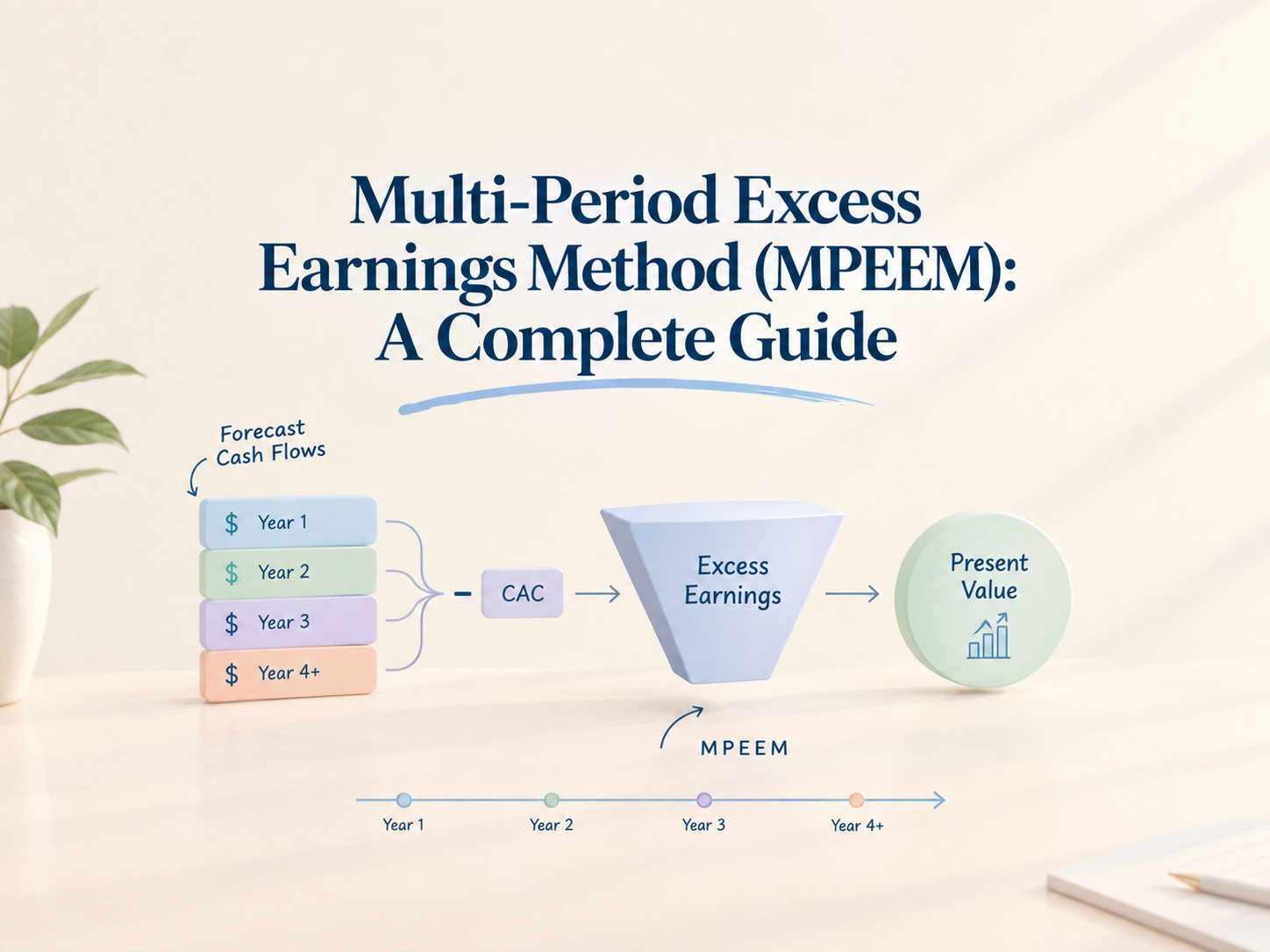
The core idea: start with the total cash flows the asset helps generate, then subtract "contributory asset charges" for every other asset that also contributes to producing those cash flows. What remains is the "excess earnings" attributable specifically to the asset being valued, hence the method's name.
Why It's Used So Often for Customer Relationships
Customer relationships illustrate the core problem perfectly. Revenue, from existing customers doesn't come from the relationship. It also depends on the workforce, technology, brand and working capital that support it. MPEEM isolates the value attributable specifically to those relationships by stripping out fair returns owed to every other asset in the mix, which is why it's central to purchase price allocations under ASC 805, where each identifiable intangible must be valued separately rather than lumped into goodwill.
The Process, Step by Step
Project the relevant cash flows. Forecast revenue attributable to the asset — for customer relationships, this means revenue from the existing customer base only, excluding future new customers.
Apply an attrition rate. Existing customers don't stay forever, so a realistic churn rate gradually reduces attributed revenue over the projection period.
Subtract operating expenses, arriving at pre-tax cash flow attributable to the asset.
Apply contributory asset charges. This is the defining step. For every contributing asset. Working capital, fixed assets assembled workforce, other intangibles. We calculate a fair return and subtract it because those assets deserve payment before any value is given to the asset in question.
Discount the excess earnings to present value, using a rate reflecting the asset's specific risk, often somewhat above the company's overall WACC.
Sum the results across all periods to arrive at the asset's estimated fair value.
Contributory Asset Charges Are the Hard Part
Getting these charges right is the most technically demanding piece of MPEEM. Working capital and fixed assets are typically charged a market-based rate of return on their fair value. Assembled workforce is often charged based on the estimated cost to recruit, hire, and train a replacement team. Other intangibles being valued separately get an appropriate royalty rate or return based on their own fair value. Missing or underestimating any of these charges inflates the excess earnings attributed to the asset — a common error auditors specifically look for.
Why the Discount Rate Often Exceeds WACC
The intangible asset being valued carries more risk than the business as a whole. Customer relationships for example carry a risk of decay that is higher, than ordinary business risk. As a result, the discount rate applied to excess earnings is generally set somewhat above the company's overall weighted average cost of capital, reflecting that asset-specific risk.
Common Pitfalls
A few recurring mistakes distort MPEEM results: an overly optimistic attrition rate that overstates customer relationship value; failing to cleanly separate existing-customer revenue from future or replacement customers; and inconsistent contributory asset charges across engagements, such as omitting a charge for assembled workforce entirely.
MPEEM answers a genuinely difficult question: how much of a combined, multi-asset cash flow stream belongs to one specific intangible asset? By starting with total attributable cash flows and systematically subtracting fair returns owed to every other contributing asset, the method isolates the excess earnings reasonably assigned to the asset in question. Careful attrition assumptions, complete contributory asset charges, and a properly calibrated discount rate are what separate a defensible valuation from one that won't survive audit scrutiny.