Loading…


Loading…
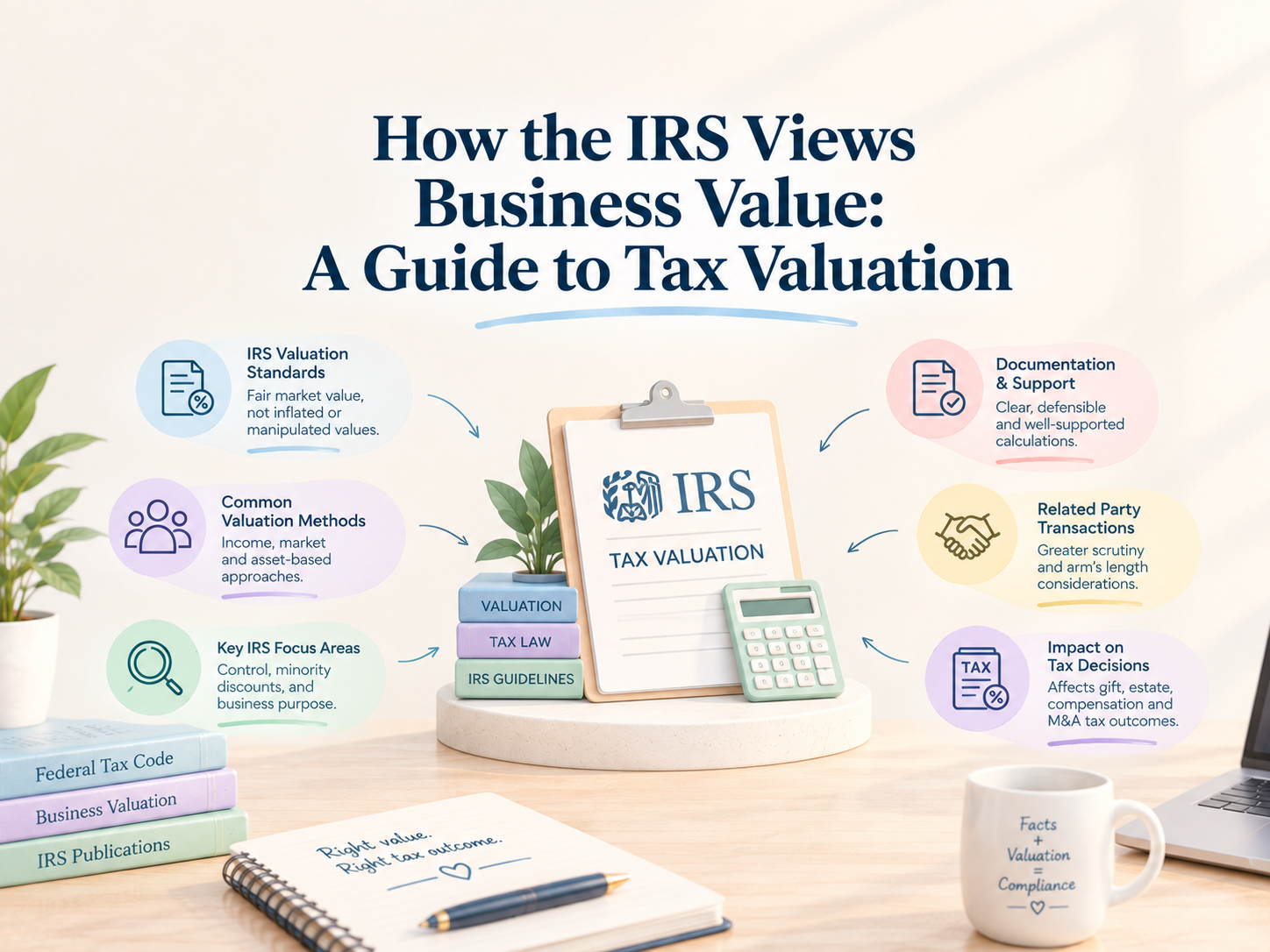
Explore how the IRS approaches business valuation for tax purposes, including fair market value, valuation methods, discounts, and the key factors that can influence a company’s taxable value.
Business owners who have sold a company, gifted company shares, transferred a business through an estate, or issued stock options to employees have likely encountered a valuation figure that does not always align with expectations. Tax valuation follows its own standards, distinct from what a buyer might pay in the open market or what appears on a company's balance sheet. Understanding how the IRS approaches business valuation is essential to avoiding unnecessary tax exposure and, in some cases, audit risk.
At the center of nearly every tax valuation is a single legal standard: Fair Market Value (FMV). The IRS defines this as the price at which property would change hands between a willing buyer and a willing seller, with neither party under any compulsion to buy or sell, and both possessing reasonable knowledge of the relevant facts.
This standard is a hypothetical construct rather than a reflection of an actual transaction. The IRS is not concerned with what a business could realistically sell for today, but with what a reasonable, informed buyer and seller would agree to under idealized, unpressured conditions. This distinction underlies the majority of valuation disputes the IRS becomes involved in.
Why Valuation Matters to the IRS
Valuation becomes relevant to the IRS whenever it affects the amount of tax owed. Common situations include the following:
In each of these scenarios, the IRS has an inherent incentive to challenge valuations that appear artificially low, since a lower valuation typically corresponds to reduced reported tax liability.
The Three Approaches the IRS Recognizes
Tax valuation generally relies on the same three broad approaches used elsewhere in finance, though with specific expectations regarding their application.
The income approach estimates value based on a business's capacity to generate future economic benefit, typically through a discounted cash flow analysis. This approach requires well-supported assumptions regarding growth, risk, and discount rates; vague or unrealistically optimistic projections are a common trigger for scrutiny.
The market approach relies on prices paid for comparable businesses or multiples derived from comparable public companies. For tax purposes, this requires genuinely comparable companies; relying on multiples from an unrelated industry is likely to invite challenge.
The asset approach values a business based on the net value of its underlying assets less liabilities. This method is more commonly applied to asset-heavy or holding companies than to operating businesses with significant goodwill.
Most credible tax valuations do not rely on a single approach; they apply two or more methods and reconcile the results, which the IRS generally regards as an indication of a more defensible conclusion.
Two valuation discounts arise frequently in tax disputes, particularly in connection with gifts and estates involving minority ownership interests:
These discounts are legitimate and supported by court precedent; however, the IRS closely examines discounts that appear inflated or lack substantive support, particularly in family-transfer arrangements where effective control remains with the same parties following the transfer.
Why Documentation Carries as Much Weight as the Valuation Itself.
A central consideration in IRS valuation disputes is that disagreements rarely concern methodology alone; they more often concern whether the valuation is well-documented and defensible. A valuation prepared by a qualified, independent appraiser, applying clearly stated assumptions, recognized methodologies, and supportable data, carries considerably more weight than an internally generated figure, even where the two conclusions do not differ significantly.
This is particularly relevant for 409A valuations and estate-related valuations, where the IRS maintains specific expectations regarding independence and documentation. Foregoing a formal valuation, or relying on an outdated one, remains one of the most common sources of unnecessary tax exposure for businesses.
The IRS does not assess business value in the manner of a prospective buyer, a lender, or an accountant. Rather, it applies the fair market value standard, grounded in hypothetical, arm's-length assumptions and evaluated against recognized valuation methodologies. Establishing an appropriate valuation requires more than identifying a defensible figure; it requires the ability to support that figure with sound methodology and adequate documentation should the IRS raise a challenge. A business owner who has an event involving a business interest. Whether it is a gift, an estate transfer, a stock grant or a sale. Will find that this distinction usually decides whether the result is a simple filing or a long dispute.