Loading…


Loading…
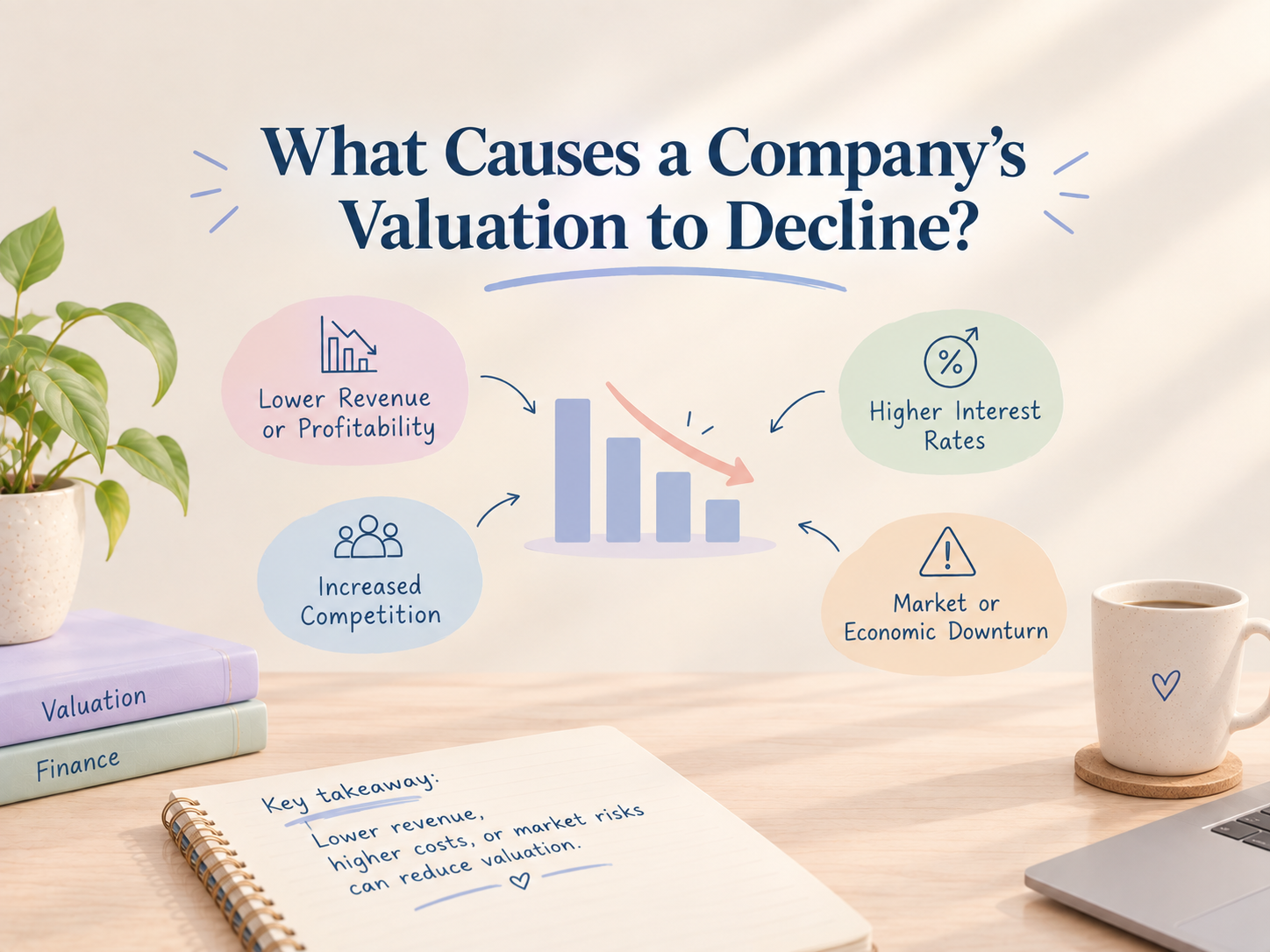
Explore the key factors that can cause a company’s valuation to decline, from weaker financial performance and slower growth to increased risk, market changes, and shifts in investor expectations.
A falling valuation rarely comes from one single event. It's usually the result of several forces compounding at once — some specific to the company, some tied to the wider market, and some driven purely by shifting investor sentiment. Understanding which category a decline actually falls into matters, because the right response looks very different depending on the real cause.
Company-Specific Causes
Missing growth or revenue targets. A company that raised money on an aggressive growth story, and then falls meaningfully short of it, faces a valuation reset almost automatically the entire premium built into the original number was based on a trajectory that no longer holds.
Margin compression. Rising costs, pricing pressure, or an inability to pass through inflation can erode margins even while revenue keeps growing, and investors reprice a business quickly once profitability, not just top-line growth, comes into question.
Cash burn outpacing available runway. A company burning through cash faster than expected, without a clear path to its next round or to profitability, faces a valuation discount tied directly to genuine solvency risk, not just disappointing performance.
Governance and leadership issues. Sudden leadership departures, auditor resignations, or disclosed compliance failures signal real risk to investors well beyond whatever the immediate financial numbers show and often trigger a much sharper markdown than the underlying operational problem alone would justify, because they raise doubts about the reliability of everything else the company has reported.
Customer or revenue concentration risk. A business that depends heavily on one large customer, one key supplier, or one narrow product line carries a structural fragility that becomes more visible, and more heavily discounted, the moment that dependency shows any sign of strain.
Market-Wide Causes
Rising interest rates. Since discount rates used in valuation are closely tied to prevailing interest rates, a rate increase mechanically lowers the present value of future cash flows across the board — a company's underlying performance can stay completely unchanged and still see its valuation compress, purely because the discount rate applied to its future earnings has gone up.
Sector-wide sentiment shifts. When people who invest get less excited about a group of companies. Like what happened with many companies that weren't making money and were growing fast once it became more expensive to get money. Even companies that are run well within that group end up being valued less. This happens just because they are part of a group that investors have become more worried, about.
Reduced funding availability. When the broader pool of available capital shrinks, later-stage companies competing for a smaller number of large checks often face lower valuations purely from reduced competition among investors, independent of anything about the company itself.
Structural and Governance-Linked Causes
Down rounds and their ripple effects. A company raising its next round below its previous valuation doesn't just reset the headline number. It can trigger anti-dilution mechanisms that further dilute existing shareholders, compounding the damage well beyond the visible valuation drop.
Loss of a credible path to liquidity. A company whose IPO timeline keeps slipping, or whose most likely acquirers have cooled on the sector, faces a valuation discount tied to genuine uncertainty about when, or whether, a real exit will actually materialize.
Investor-specific markdowns. Investors who sit on the cap table can see a company’s worth, in very different ways. Each investor follows a method and weighs recent news differently. Because of this a valuation decline that one investor reports does not become a universally agreed number. Every investor may calculate a valuation decline so the figure can vary widely.
Why the Real Cause Matters
A drop in valuation caused by something like a change in interest rates or a broad shift in how the market feels about an industry is not the same as one caused by a company failing to meet its own goals or dealing with problems, in leadership. The first often resolves as conditions change; the second usually requires the company to demonstrably fix the underlying problem before investor confidence, and the valuation, recovers. Conflating the two, or hoping a company-specific problem will simply fix itself once markets improve, is one of the more common mistakes founders and boards make when a valuation starts sliding.
When a valuation drops the first real question to ask isn't how much it fell. It's why. A decline rooted in real, verifiable fundamentals demands an operational fix. A decline rooted in market-wide multiple compression may simply require patience and a credible plan for when conditions turn. Getting this diagnosis right is what separates a company that recovers its valuation over time from one that keeps sliding because it never actually addressed the real cause.