Loading…


Loading…
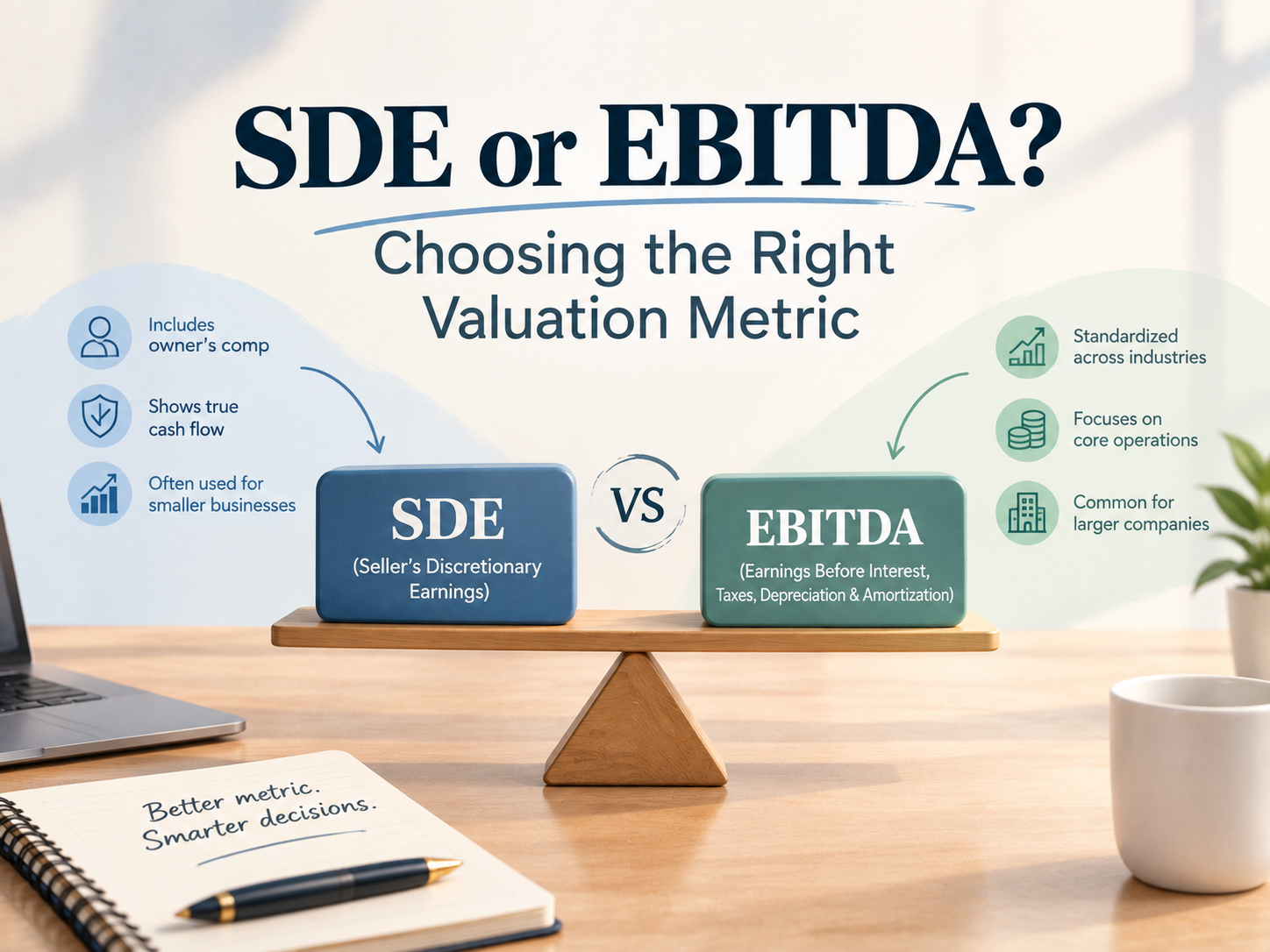
SDE and EBITDA serve different purposes in business valuation. Learn which metric is more appropriate based on business size, owner involvement, profitability, and the type of buyer.
When valuing a small business versus a mid-sized company, two similarly named metrics come into play: SDE and EBITDA. Both measure earnings prior to valuation, but each is designed for a different type of business, and applying the wrong one can materially distort a valuation.
SDE: For Owner-Operated Businesses
SDE, or Seller's Discretionary Earnings, is designed for small, owner-operated businesses such as local restaurants or single-location retail operations. The calculation begins with net income and adds back the owner's salary, personal expenses run through the business, and other discretionary spending. It captures the full financial benefit the current owner derives from the business, on the assumption that a buyer will step into the owner's role and run it personally.
EBITDA: For Established, Management-Run Businesses
EBITDA, or Earnings Before Interest, Taxes, Depreciation, and Amortization, is the standard for larger, more mature businesses with management teams that do not depend on a single individual. It also starts with net income, but adds back interest, taxes, depreciation, and amortization, factors tied to financing and accounting choices rather than operational performance. EBITDA assumes the business functions independently of any one person.
The Core Distinction
The real dividing line is not company size, but how dependent the business is on its owner. If the owner effectively is the business, SDE is the more accurate metric. If an established management team runs day-to-day operations, EBITDA better reflects what a passive or financial buyer could expect.
As a general guideline, businesses under roughly $1–2 million in revenue, or without a management layer, typically use SDE; those above $2–5 million with an established management structure typically shift to EBITDA. This is a guideline, not a fixed rule and the determining factor remains owner dependency, not revenue alone.
Why the Wrong Metric Distorts Value
Treating SDE and EBITDA interchangeably is a common and costly error. Valuing a business on SDE multiples while calculating earnings as EBITDA, without adding back the owner's full compensation understates the business's value to a hands-on buyer. Conversely, applying EBITDA-style multiples to an SDE figure overstates value, since SDE already includes compensation an EBITDA-based buyer wouldn't separately add back.
The multiples themselves differ substantially: SDE multiples typically range from 2x to 4x, while EBITDA multiples for larger private companies often start at 4x to 8x or higher, depending on industry and growth. Mismatching the multiple to the metric can distort a valuation significantly in either direction.
Therefore,SDE and EBITDA aren't competing methods ,they suit different types of businesses. SDE fits owner-operated businesses where the buyer works directly in the company; EBITDA fits businesses with management structures where earnings persist independent of any one individual. Choosing the right metric, and the multiple that matches it, is essential to an accurate valuation.