
Terminal Value in DCF: Gordon Growth vs. Exit Multiple
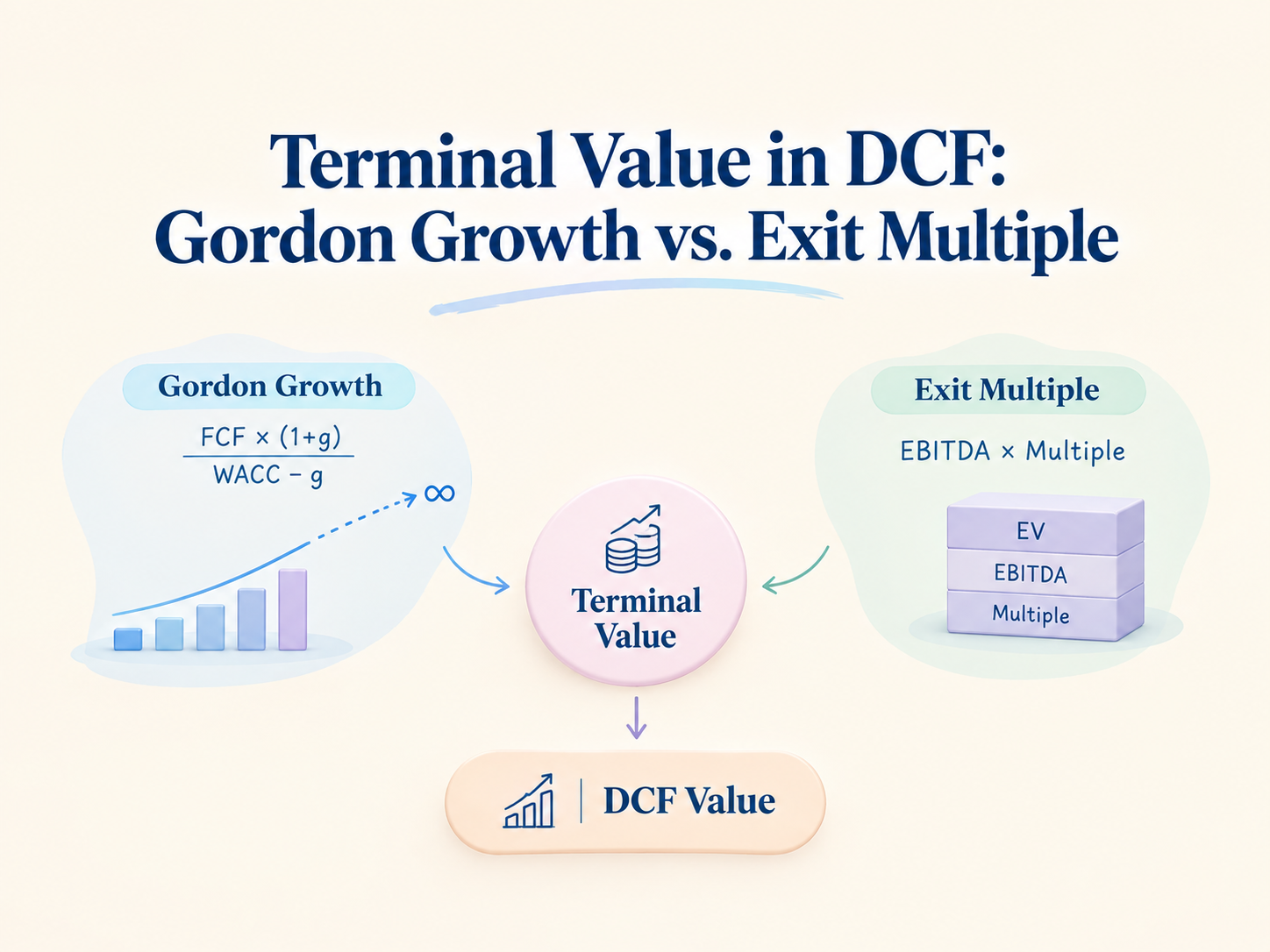
Understand the two common approaches to terminal value in DCF valuation—Gordon Growth and Exit Multiple—and how their assumptions, calculations, and applications can influence the estimated value of a business.
Terminal value can represent a significant portion of a company's total DCF value, particularly when the explicit forecast period is relatively short. As a result, the method used to calculate terminal value can have a substantial impact on the overall valuation.
The two most common approaches are the Gordon Growth Method and the Exit Multiple Method. Both are intended to estimate the value of the business beyond the explicit forecast period, but they rely on fundamentally different assumptions. Understanding those assumptions is essential when determining which approach is appropriate.
Gordon Growth Method: Valuing the Business as a Perpetuity
The Gordon Growth Method, also known as the Perpetuity Growth Method, assumes that the business will continue generating cash flows indefinitely and that those cash flows will grow at a stable rate over the long term.
The standard formula is:
Terminal Value = Final Year FCF × (1 + g) ÷ (WACC − g)
where:
- FCF = Free Cash Flow in the final forecast year
- g = Long-term perpetual growth rate
- WACC = Weighted Average Cost of Capital
The terminal growth rate is one of the most important assumptions in this method. It should represent a sustainable long-term growth rate that is consistent with the company's mature operating environment and broader economic conditions.
A perpetual growth rate that is excessively high can materially overstate terminal value. This is particularly important because the formula is highly sensitive to the difference between the discount rate and the terminal growth rate. Even a modest change in either assumption can result in a significant change in the calculated terminal value.
Exit Multiple Method: Using Market-Based Valuation
The Exit Multiple Method takes a different approach. Instead of assuming a perpetual growth rate, it applies a valuation multiple to a financial metric in the final forecast year.
A commonly used multiple is Enterprise Value / EBITDA (EV/EBITDA).
The basic formula is:
Terminal Value = Final Year EBITDA × Exit Multiple
The selected multiple is generally informed by comparable public companies, precedent transactions, or other relevant market evidence.
The primary challenge with this approach is determining an appropriate terminal multiple. Current market multiples may reflect temporary market conditions, sector-specific trends, or unusually high or low investor expectations. Assuming that the same multiple will remain appropriate several years into the future may therefore introduce significant valuation risk. The selected multiple should also be consistent with the company's expected growth, profitability, risk profile, size, and competitive position at the end of the forecast period.
Why the Two Methods Can Produce Different Results
The Gordon Growth and Exit Multiple methods approach terminal value from different perspectives.
The Gordon Growth Method focuses on the company's ability to generate sustainable cash flows and grow them over the long term. The Exit Multiple Method, by contrast, relies on how comparable businesses are expected to be valued by the market. As a result, the two methods can produce materially different terminal values even when the underlying forecast is the same.
A significant difference between the results should not simply be averaged away. It can be useful to examine what is driving the difference. For example, an exit multiple may imply a perpetual growth rate that is inconsistent with the company's expected long-term growth prospects. Conversely, a selected perpetual growth rate may imply an exit multiple that appears difficult to reconcile with relevant market evidence.
These implied assumptions can provide an important cross-check on the reasonableness of the valuation.
Why Valuers Often Consider Both Methods
Using both approaches can provide a useful sensitivity and reasonableness check.
A valuation professional may calculate terminal value using the Gordon Growth Method and then determine the exit multiple implied by that result. Similarly, an Exit Multiple valuation can be converted into an implied perpetual growth rate. This allows the assumptions underlying each method to be compared directly.
For example, if a 3% perpetual growth rate produces a terminal value equivalent to an unusually high exit multiple relative to comparable companies, the assumptions may warrant further review. The same applies when a market-based exit multiple implies a perpetual growth rate that appears difficult to sustain over the long term.
The objective is not necessarily to make the two methods produce the same result, but to understand why they differ and determine whether the underlying assumptions are reasonable.
Which Method Is More Appropriate?
There is no universally appropriate method for every valuation. The Gordon Growth Method is often useful when the business is expected to operate as a stable going concern with predictable long-term cash flows and a sustainable growth rate that can be reasonably estimated.
The Exit Multiple Method may be more relevant when there is strong market evidence from comparable companies or transactions and when a market-based valuation framework is consistent with the purpose of the analysis. The nature of the business, forecast period, industry dynamics, availability of comparable data, and purpose of the valuation should all be considered when selecting the appropriate approach.
Both the Gordon Growth and Exit Multiple methods can provide a reasonable framework for estimating terminal value, but neither should be applied mechanically. The Gordon Growth Method is particularly sensitive to the perpetual growth rate and discount rate, while the Exit Multiple Method is highly dependent on the selected terminal multiple and the quality of the comparable market evidence. Calculating terminal value using both approaches can provide a useful cross-check, but the most important step is understanding the assumptions behind each result. A defensible terminal value is not simply the number that produces the desired valuation. It is the result of assumptions that are consistent with the company's expected long-term performance, market conditions, and overall risk profile.