Loading…


Loading…
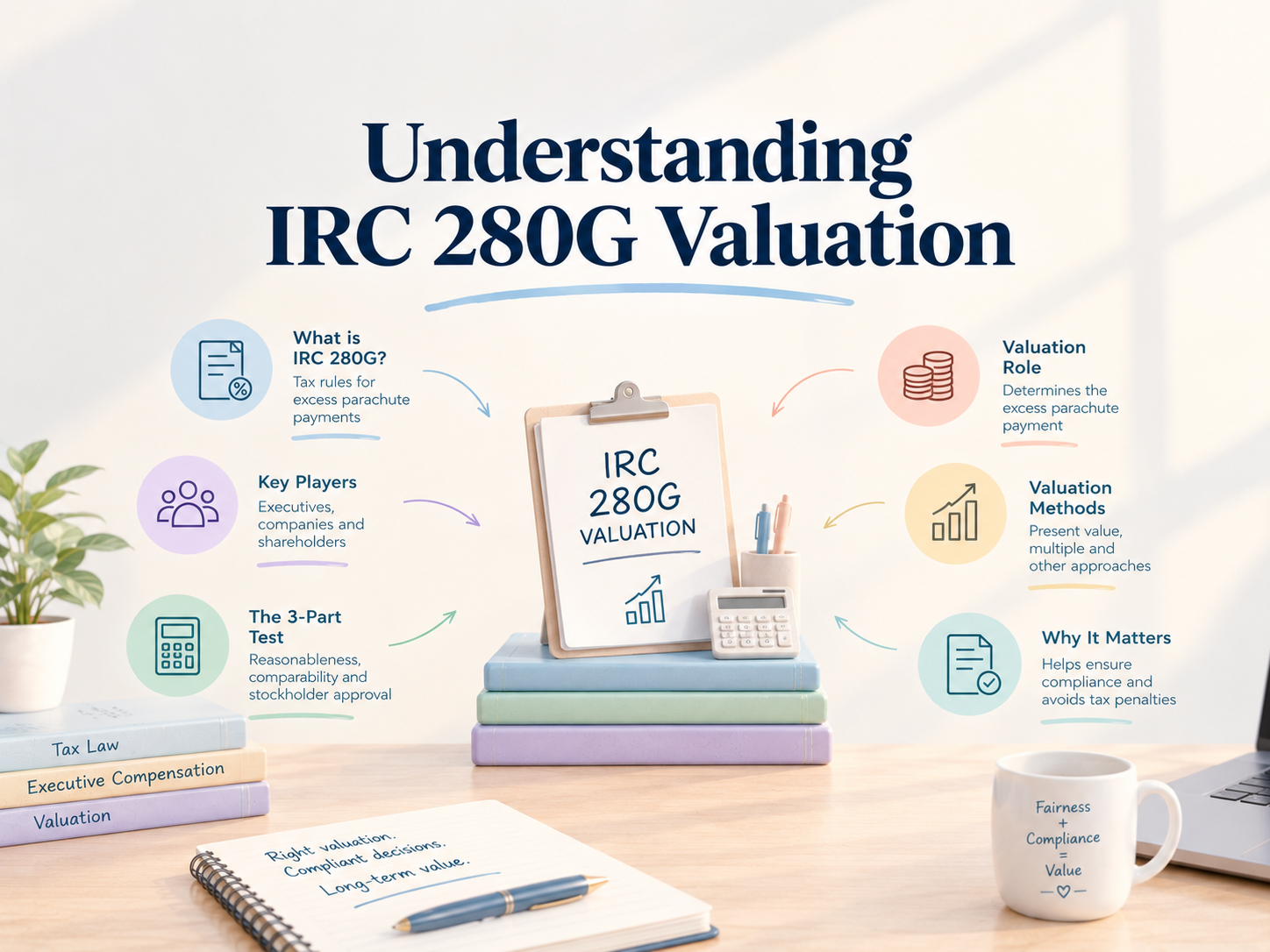
Understand IRC Section 280G valuation, including how change-in-control payments are assessed, the role of reasonable compensation, and the key valuation considerations for executives and businesses.
Mergers and acquisitions often trigger substantial compensation payments to senior executives, commonly referred to as "golden parachutes." These payments are governed by a specific provision of the U.S. tax code, IRC Section 280G, which imposes significant tax consequences when compensation tied to a change in control exceeds certain thresholds. A clear understanding of how this provision operates, and how the underlying valuation is conducted, is essential for any company approaching a transaction of this kind.
Section 280G was designed to limit excessive compensation awarded in connection with a change in control. It applies to individuals the tax code classifies as "disqualified individuals," a category that generally includes corporate officers, highly compensated employees, and shareholders holding meaningful equity positions.
The provision measures total change-in-control payments against a benchmark known as the base amount, defined as an individual's average annual compensation over the five calendar years preceding the transaction. If total payments reach or exceed three times this base amount, the portion exceeding one times the base amount is treated as an "excess parachute payment." This classification carries two direct consequences: the company forfeits its tax deduction for the excess amount, and the individual becomes subject to an additional 20% excise tax on top of standard income tax.
A proper 280G analysis depends heavily on valuation, since several of its core components cannot be determined through simple accounting calculations alone.
Equity acceleration typically represents the most significant valuation component. When a transaction accelerates vesting for stock options, restricted stock, or similar equity awards, the value attributable to that acceleration must be calculated and incorporated into total parachute payments. This requires establishing the fair value of the underlying equity and, for options, applying an appropriate option-pricing methodology.
Non-compete agreements introduce a further valuation-dependent adjustment. Payments genuinely attributable to an enforceable non-compete arrangement may be excluded from the parachute payment calculation, but only to the extent their value is properly supported through a defensible valuation analysis, generally grounded in the economic harm the company avoids by restricting the executive's ability to compete.
Reasonable compensation for future services functions similarly. Payments that can be shown to reflect fair value for services an executive will provide following the transaction may reduce the parachute payment calculation, though this exclusion depends entirely on a credible valuation of what those future services are actually worth.
Calculating the Base Amount Correctly
The base amount calculation forms the foundation of the entire 280G analysis, and errors here can materially distort the outcome. It is generally derived from the individual's average annual taxable compensation across a five-year "base period" preceding the transaction. In practice, this calculation often requires close attention to W-2 compensation history, the timing of specific payments, and adjustments for partial years of employment or irregular compensation patterns.
Because the base amount serves as the threshold against which every parachute payment is measured, even minor calculation errors can shift a transaction's outcome from compliant to non-compliant under Section 280G.
The Consequences of Getting Valuation Wrong
Given how heavily Section 280G relies on valuation, inaccuracies can carry real financial consequences for both the company and the affected individual. An understated equity valuation, an unsupported non-compete allocation, or a flawed base amount calculation can each cause a company to inadvertently exceed the excess parachute payment threshold, resulting in a lost tax deduction for the business and an unanticipated excise tax liability for the executive.
For this reason, companies preparing for a change-in-control transaction generally engage qualified valuation professionals well in advance of closing, rather than addressing 280G compliance at the final stage of a deal. Early analysis allows a company to model potential outcomes, evaluate mitigating options such as shareholder approval procedures available to certain privately held companies, and avoid unexpected tax consequences for executives around the time of closing.
Section 280G is a way to value things inside the tax rules. This process has money effects. The company might lose a tax deduction. The executive might have to pay an extra tax. These effects depend completely on how the starting number is calculated, how quickly the stock is valued and any real exceptions that are claimed for not competing or for future work. Companies that are getting ready for a deal should see 280G valuation as an important step in planning the deal. This is because if the valuation is wrong both the company and the executives, who the rule is meant to help end up paying the cost.