
Valuing US E-Commerce Businesses in 2026
Explore how U.S. e-commerce businesses are valued in 2026, including revenue growth, profitability, customer metrics, brand strength, market multiples, and other factors shaping business value.
The aggregator era that once drove ecommerce valuations to speculative highs has largely collapsed. Thrasio filed for Chapter 11 in 2024 and emerged smaller. Perch was absorbed by Razor Group and no longer operates as an independent buyer. Berlin Brands Group and several other European aggregators have similarly restructured. What's replaced that era is a smaller, more disciplined buyer pool underwriting fundamentals rather than pure growth and that shift has reshaped how every ecommerce business, not just DTC brands specifically, actually gets valued.
The Multiple Range, and Where a Business Actually Lands in It
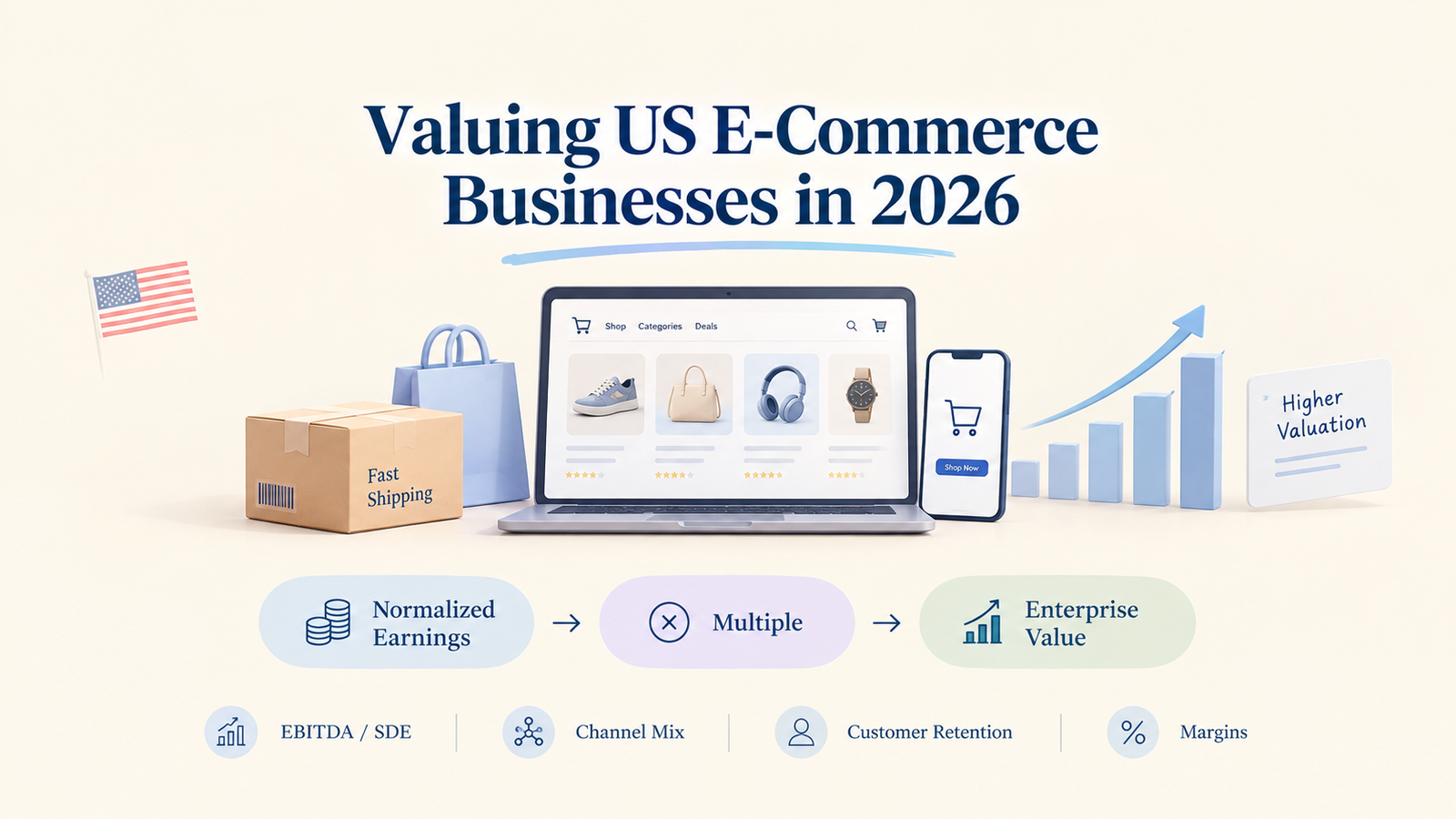
Ecommerce businesses in 2026 generally transact between 2.5x and 10x EBITDA, with the specific range depending heavily on size and business model. Smaller operations under roughly $5 million in revenue are commonly valued on SDE (Seller's Discretionary Earnings) rather than EBITDA, typically in the 1.5x to 3.5x range, since the founder is still deeply embedded in day-to-day operations. Once a business has built a real management team. No longer relies on the founder personally buyers shift how they value the company. They start using EBITDA, which's almost always the higher-value measure. Companies that are larger and professionally managed often get valuations of 7 times EBITDA or more.
Public ecommerce comparables average around 12.6x EBITDA, which functions as a useful ceiling reference for how far private multiples could theoretically expand, rather than a realistic target for most private transactions.
Why Channel Matters as Much as Size
This is where 2026 diverges sharply from the growth-at-all-costs era. The exact same revenue and EBITDA figures can produce meaningfully different valuations depending on which channel actually generates them.
Amazon-dependent businesses, following the aggregator collapse, now price at roughly 3x to 4x in most categories. A direct consequence of buyers no longer being willing to pay a premium for revenue concentrated on a single platform they don't control. Subscription-based ecommerce models can achieve 4x to 10x ARR depending on churn, reflecting the predictability subscription revenue offers over one-off transactions. Hybrid businesses combining ecommerce with physical retail presence, and brands with genuinely diversified channels across DTC, Amazon, and wholesale, consistently command the highest multiples in the current market, since that diversification meaningfully reduces platform-specific risk.
The Fundamentals Buyers Are Actually Underwriting
Customer acquisition cost against lifetime value, along with payback period and repeat purchase rate, and critically how each of these has trended over time, not just where they stand today. A business showing improving unit economics tells a very different story than one with static or declining numbers, even at similar current metrics.
Owned audience versus paid dependency. A business built entirely on paid social acquisition draws a lower multiple, given rising paid acquisition costs and platform risk. Strong organic traffic, SEO, or a meaningful email and SMS list command a real premium, since they signal a defensible, owned audience that doesn't erode the moment ad costs rise.
Net margin after ad spend. Margins above roughly 15% after fully loaded acquisition costs signal a genuinely scalable, healthy brand . A bar that filters out much of the growth-at-any-cost thinking that defined the 2021 boom.
Explainable trends. A buyer who can't get a clear explanation for a revenue or margin trend up or down tends to assume the worst, treating an unexplained decline as evidence of structural decay rather than a temporary blip.
Who's Actually Buying in 2026
The buyer pool has genuinely diversified beyond the now-diminished aggregators. Private equity firms and strategic acquirers remain active and typically pay the strongest multiples, particularly where real operational synergies exist.A new group of people who buy companies. Category leaders, family offices creating consumer collections and search funds. Has started to have a real impact especially in the $1 million to $10 million revenue range. These buyers often set up deals with a lot of seller financing. Look for businesses they can really take over and run themselves.
Ecommerce valuation in 2026 rewards exactly what the 2021 aggregator boom didn't: durable margins, channel diversification, an owned customer base, and a growth story a buyer can actually verify and explain. The multiple a specific business lands at has less to do with its size alone, and more to do with how convincingly it can demonstrate these fundamentals to a buyer pool that's grown considerably more disciplined than it was just a few years ago.